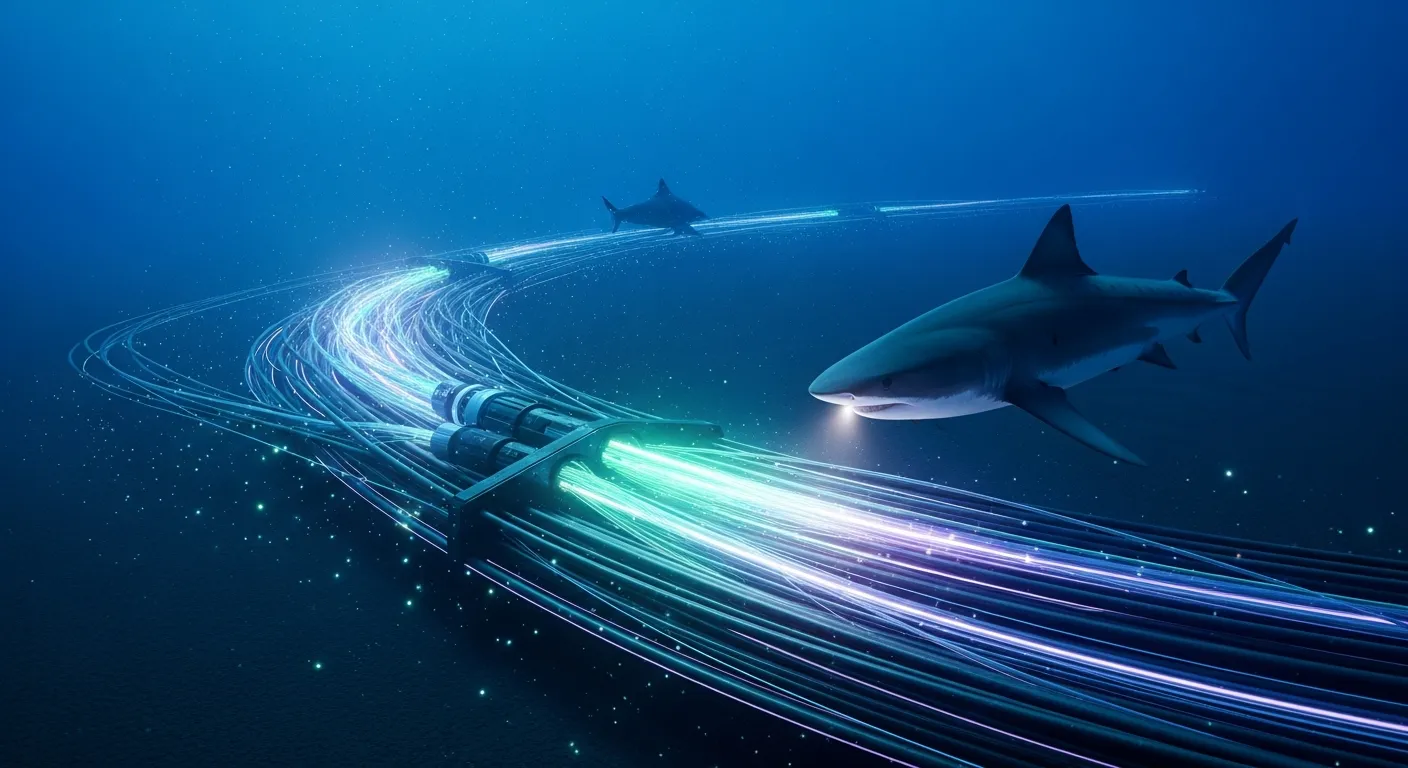

Right now, as you read this, your data is probably traveling through a cable sitting on the bottom of the ocean. Not a satellite. Not some wireless magic beam. A cable. On the seafloor.
And it's about as thick as a garden hose.
The Invisible Backbone of Everything
Here's a number that breaks most people's brains: over 99% of all intercontinental data traffic travels through submarine communications cables. Not 50%. Not 80%. Basically all of it.
We're talking about roughly 600 cables crisscrossing the planet right now, stretching over 1.4 million kilometers in total. If you laid them end to end, they'd wrap around the Earth about 35 times. These fiber optic threads carry your emails, video calls, streaming binges, financial transactions, and that meme your friend sent you at 2 AM.
The whole system is so critical that if enough cables went down simultaneously, entire countries could lose internet access. And yes, that has actually happened.
Thinner Than You Think, Tougher Than You'd Expect
In the deep ocean, these cables are about 25 millimeters in diameter. That's roughly one inch. The core is a bundle of optical fibers, each thinner than a human hair, wrapped in layers of steel wire, copper tubing, and polyethylene. Near shorelines, the cables get beefier with extra armor to handle anchors, fishing nets, and the general chaos of shallow water.
They're laid by specialized ships that slowly unspool cable from massive drums, lowering it to the ocean floor at depths that can exceed 8,000 meters. The process is painfully slow. A single transatlantic cable run can take weeks.
And when something goes wrong? A different specialized ship has to sail out, locate the break (sometimes in total darkness at crushing depths), grapple the cable up from the seafloor, splice it, and lay it back down. It's like performing surgery on a needle at the bottom of a swimming pool. Blindfolded.
Yes, Sharks Actually Bite Internet Cables
This isn't an urban legend. Sharks have been documented biting submarine cables since at least the 1980s. The leading theory? The electromagnetic fields generated by the cables mimic the bioelectric signals of prey. Sharks have specialized electroreceptor organs called ampullae of Lorenzini that detect these signals. So from a shark's perspective, that cable looks like dinner.
Google actually had to reinforce some of its undersea cables with Kevlar-like material after shark attacks. Let that sink in: one of the world's biggest tech companies had to shark-proof its internet cables.
But sharks aren't even the biggest threat. Fishing trawlers and ship anchors cause the majority of cable damage. In 2008, cable cuts near Alexandria, Egypt knocked out internet service across large parts of the Middle East, India, and Southeast Asia. Millions of people lost connectivity because of a few severed cables in the Mediterranean.
The Secret Map Under the Sea
You can actually see where all these cables run. The Submarine Cable Map (submarinecablemap.com) shows every active and planned submarine cable on Earth. Zoom in and you'll notice some fascinating patterns. Cables cluster around major population centers. Some routes haven't changed much since the telegraph era of the 1850s. Certain chokepoints, like the Strait of Malacca or the Red Sea, are packed with cables because geography forces them through narrow passages.
These chokepoints make security experts nervous. A single event at the right location could sever dozens of cables simultaneously. It's one reason why governments have started treating submarine cables as critical national infrastructure, complete with military protection and classified repair protocols.
How undersea cables actually get laid across entire oceans.
The First Cable Was a Disaster (Obviously)
The first transatlantic telegraph cable, completed in 1858 and championed by entrepreneur Cyrus West Field, was celebrated with parades and fireworks. Queen Victoria sent a 98-word greeting to President Buchanan. The transmission took 16 hours.
The cable worked for about a month before it completely failed. The chief electrician had been using dangerously high voltages to force signals through, essentially frying the insulation from the inside. It took another eight years before a successful permanent cable was laid in 1866.
Think about that. In 1858, people were sending messages across the Atlantic through a wire on the ocean floor. Today, the principle hasn't really changed. The wires are just way, way better.
Your Data's Wild Ride
Next time you load a website hosted on another continent, picture this: your request is traveling as pulses of light through glass fibers thinner than hair, inside a cable sitting on the bottom of the ocean, possibly near a curious shark, traveling at close to the speed of light across thousands of kilometers of dark water.
And it all happens in milliseconds.
The most impressive technology in the world isn't flashy. It's sitting quietly on the ocean floor, doing its job. And occasionally getting nibbled on by a shark.