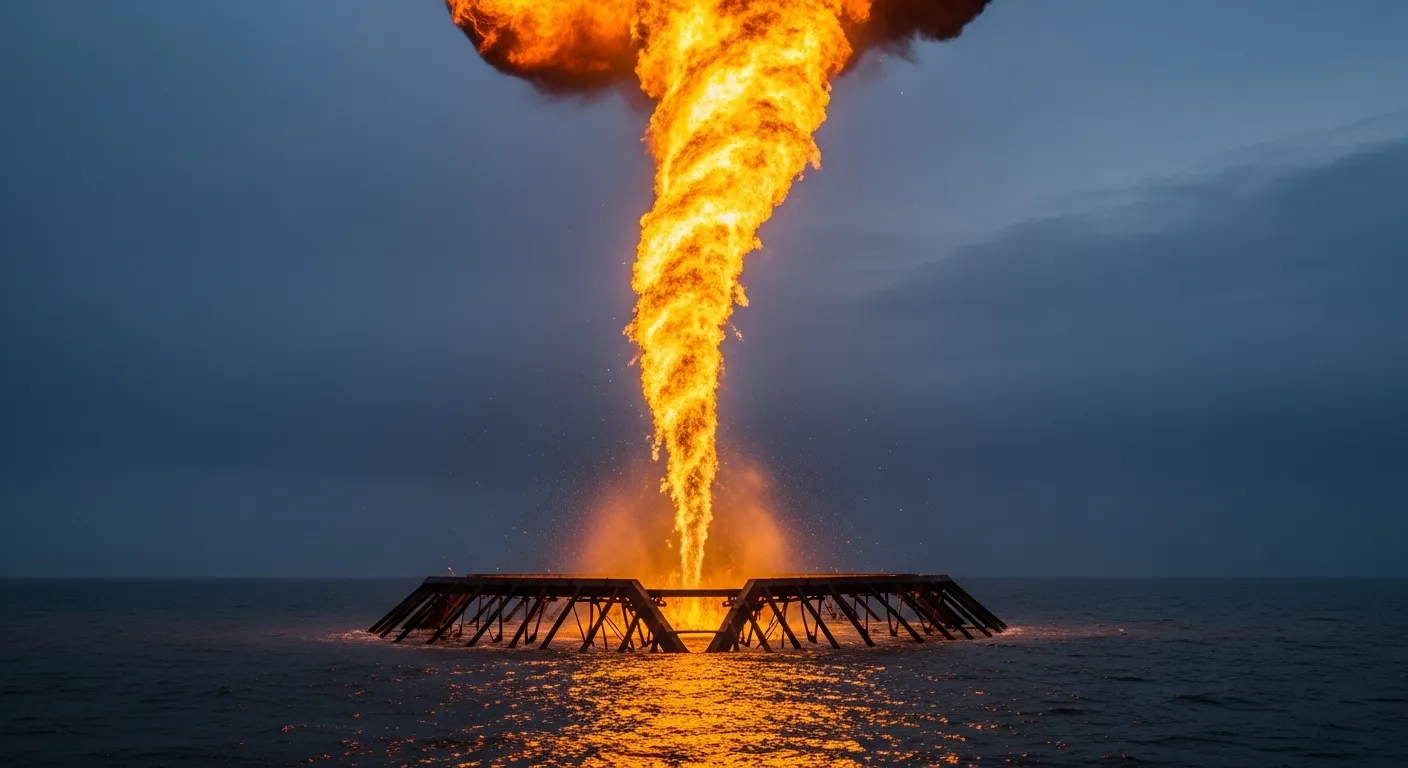

Scientists at Texas A&M University have built a 17-foot tall fire tornado. On purpose. And the reason is genuinely brilliant.
Here is the problem: when oil spills happen in the ocean, our options for cleaning them up are... not great. We can try to scoop it up with booms and skimmers. We can spray chemical dispersants (which have their own environmental concerns). Or we can just light the oil on fire where it sits on the water, a method called "in-situ burning."
That last option actually works pretty well at keeping the oil from spreading. It was used during the Deepwater Horizon disaster in 2010, when 4.9 million barrels of crude gushed into the Gulf of Mexico. But regular in-situ burning has a nasty side effect: it produces thick, black smoke loaded with carbon dioxide and soot. It also leaves behind a sticky residue on the water that still needs to be cleaned up. So you are solving one environmental problem while creating another.
Enter the Fire Tornado
The Texas A&M team, led by aerospace engineering professor Elaine Oran, figured out something clever. What if you could make the fire burn better? Not bigger. Better. More complete. Less leftover gunk.
Their solution: a 16-foot triangular structure that twists airflow around a column of flame sitting on oil-coated water. The swirling air coaxes the fire into a spinning vortex that stretches 17 feet into the sky. A literal fire tornado.
And it is not just for show. The vortex structure does something important: it pulls a continuous stream of oxygen along the entire height of the flame column. More oxygen means hotter flames. Hotter flames mean more complete combustion. More complete combustion means the fire actually vaporizes particles instead of turning them into soot.
The Numbers Are Wild
In testing, the fire whirl burned off 95% of the oil slick. Compare that to standard in-situ burns, which leave a lot more behind. It also produced 40% less soot and burned through the fuel 40% faster than conventional methods.
Think about that for a second. A spinning column of fire that cleans up almost all the oil, produces significantly less pollution, and does it nearly twice as fast. It sounds like something from a disaster movie, except it actually works.
The Catch (There Is Always a Catch)
The researchers are upfront about the limitations. Their tests were done in controlled conditions, not on the open ocean with waves, wind, and unpredictable currents. Deploying a 16-foot triangular structure on a heaving sea surface is, to put it mildly, a different engineering challenge.
But this is proof-of-concept territory. The physics works. The chemistry works. Now it is an engineering problem, and engineering problems tend to get solved when the motivation is strong enough. Given that we have leaked over 300,000 barrels of oil into the oceans just in the last few years, the motivation is there.
Beyond Oil Spills
Professor Oran sees applications way beyond ocean cleanup. Understanding how fire whirls work at a fundamental physics level could inform the design of next-generation combustion systems. Think more efficient engines, better industrial furnaces, cleaner power generation.
"Our study has universal applications," Oran says. "By understanding the physical laws that govern fire whirls, we can harness their power beyond oil spill remediation."
So the next time someone tells you that fighting fire with fire is a bad idea, point them to Texas A&M. Sometimes the best way to clean up a disaster is to set it spinning.
The research was published in the journal Fuel.