
The Boötes Void: The Creepiest Nothing in the Universe
There is a hole in our Universe. Not a metaphorical one. A literal, 330-million-light-year-wide expanse of almost nothing. And it is absolutely terrifying.
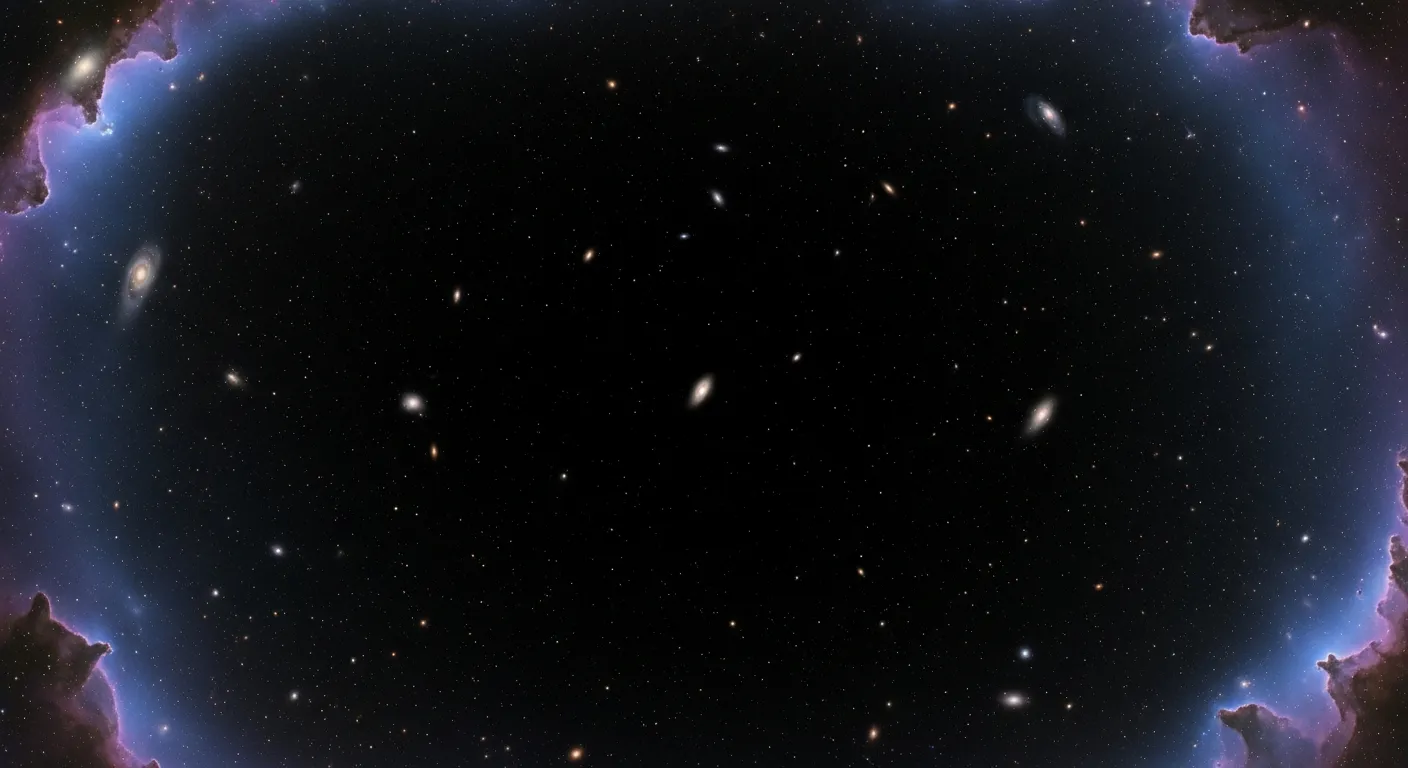
Imagine looking up at the night sky and seeing absolutely no stars. Not because of clouds. Not because of light pollution. Because there is simply nothing there. Welcome to the Boötes Void, sometimes called "The Great Nothing," and it is the largest empty region in the known cosmos.
The Scale is Impossible to Grasp
The Boötes Void spans 330 million light-years across. To put that in perspective, if you started traveling at the speed of light right now, you would still be inside this cosmic dead zone when dinosaurs were roaming Earth. That is how ridiculously large it is.
Here is where it gets really weird. In a region this size, we would expect to find around 2,000 galaxies. The Boötes Void contains about 60. Total. And most of those are clustered in a tube-shaped region running through the middle, like a cosmic artery keeping the emptiness alive. The rest is just... void.
The Mind-Bending "What If"
Here is the part that will break your brain: if our Milky Way galaxy happened to be located at the center of the Boötes Void, humanity would not have discovered other galaxies until the 1960s. Think about that. No Andromeda. No Hubble Deep Field. No understanding that we live in a universe with hundreds of billions of galaxies. Just our lonely island of stars, surrounded by an ocean of nothing stretching for hundreds of millions of light-years in every direction.
Our entire understanding of the cosmos would be completely different. The Copernican principle, the idea that Earth is not special, would never have developed. We might still think the Milky Way was the entire Universe.
Discovered by Accident
The Boötes Void was not found by some genius theoretical prediction. It was discovered completely by accident in 1981 during a survey of galaxy redshifts. Astronomers were just mapping the universe, doing their usual astronomy thing, and suddenly went "Wait, where did all the galaxies go?"
It sits about 700 million light-years from Earth in the constellation Boötes, which represents a herdsman eternally pushing his plough around the pole star. Apparently, even ancient mythmakers thought this patch of sky looked empty.
Why Does It Exist?
The honest answer is we are not entirely sure. The leading theory involves the "cosmic web," the large-scale structure of the universe where matter clumps into filaments and sheets, leaving huge voids in between. Think of it like bubbles in foam. The Boötes Void is just one really, really big bubble.
But even that does not fully explain why THIS void is SO empty. Some researchers have suggested it formed from the merger of smaller voids over billions of years. Others wonder if there is something else going on that we simply do not understand yet.
The Universe is Mostly Nothing
Here is the wildest part: the Boötes Void is not even unique. Voids make up about 80% of the known Universe. Our own Milky Way sits in something called the KBC Void, though it is tiny compared to the Boötes monster.
So next time you feel small looking up at the stars, remember: most of the universe is not stars. It is vast, empty nothingness. And somewhere out there, 700 million light-years away, the Boötes Void waits. Silent. Dark. Absolutely enormous.
Sleep tight.