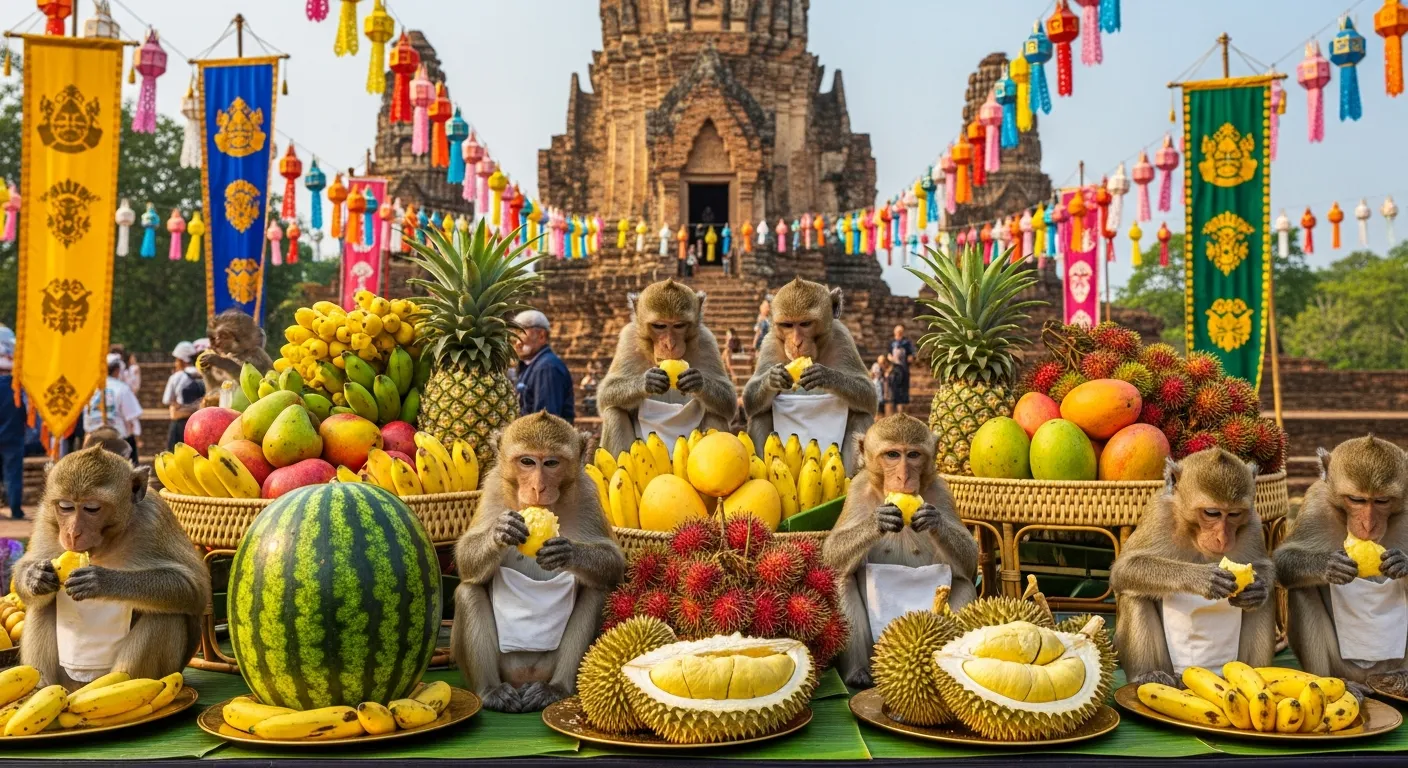

In the middle of Thailand, there's a town where the locals roll out red carpets, set up elaborate fruit towers, and serve gourmet meals. The guests of honor? About 3,000 macaque monkeys who show up in tuxedo vests. Okay, the vests aren't real, but everything else is.
Welcome to the Monkey Buffet Festival in Lopburi, Thailand. And yes, it's exactly what it sounds like.
The Most Exclusive Dinner Party in Thailand
Every year on the last Sunday of November, the people of Lopburi transform their town into an all-you-can-eat paradise for the local monkey population. We're talking 4,000 kilograms of fruits, vegetables, cakes, sodas, and even ice cream sculptures. The spread includes watermelons carved into intricate designs, towers of bananas that would make a Minions movie jealous, and enough tropical fruit to bankrupt a smoothie bar.
The total cost? Around $10,000 to $15,000 worth of food, all devoured within hours by furry guests who definitely don't use napkins.
But Why Though?
Here's where it gets interesting. This isn't just Thai people being eccentric. The festival has roots in an ancient Hindu epic called the Ramayana. According to legend, the monkey king Hanuman helped Prince Rama rescue his wife from a demon king. The town of Lopburi believes Hanuman founded their city, and the monkeys roaming the streets today are considered his descendants. They're sacred. Messing with them is like swearing in church, except the church is everywhere and the congregation can climb walls.
The monkeys aren't just tolerated. They're fed, protected, and now, annually celebrated with what is essentially the world's most expensive petting zoo experience.
Life with 3,000 Sacred Monkeys
The macaques of Lopburi don't wait for the festival. They run this town year-round. They steal food from tourists, break into shops, swing from power lines, and generally behave like they own the place. Because legally and spiritually, they kind of do.
Locals have adapted. Shopkeepers keep their doors closed. Tourists are warned not to carry food openly. The monkeys have learned to open zippers, untie bags, and identify which tourists are carrying bananas. They're basically tiny, furry street criminals with diplomatic immunity.
The Festival Itself
The Monkey Buffet Festival starts with a human parade featuring people in monkey costumes, because apparently regular monkeys weren't enough. Then comes the main event: volunteers set up massive tables laden with food while actual monkeys watch from rooftops, power lines, and temple ruins with the patience of experienced food critics.
Once the signal is given, it's chaos. Monkeys descend from every direction. They fight over pineapples. They share soda bottles (yes, they figured out how to open them). Some politely sit and eat. Others grab everything they can carry and flee to their secret stashes. It's Lord of the Flies meets a catering convention.
The best part? The monkeys have preferences. They'll ignore plain vegetables if there's durian available. They have favorite vendors. Some are shy; others are aggressively entrepreneurial. Tourists who visit regularly can recognize individual monkeys by personality.
The Tourism Angle
Lopburi is about 150 kilometers north of Bangkok, and before the monkeys, it was primarily known for ancient Khmer temple ruins. Now? It's the Monkey Town. The festival draws thousands of tourists annually, all hoping to get a photo of a monkey eating a slice of watermelon the size of its head.
Is it weird? Absolutely. Is it profitable? Also yes. Local hotels, restaurants, and shops depend on monkey tourism. The town even has a monkey temple where visitors can feed them daily, though the buffet festival is the Super Bowl of monkey dining.
The Science Says... Maybe Don't
Here's the uncomfortable part. Conservationists and some animal welfare groups aren't fans. The monkey population has exploded because of all the human feeding. There are now about 3,000 macaques in a town that probably should support half that number. They've become aggressive, overpopulated, and occasionally violent.
In 2020, the monkeys briefly took over the town during COVID lockdowns when tourists disappeared and their food sources dried up. Gangs of hungry macaques fought in the streets. It was like a furry apocalypse. Local authorities had to organize mass sterilization programs and consider relocating some monkeys to nearby forests.
The festival continues, but there's an ongoing debate: are the monkeys a blessing, a tourist attraction, or a public health hazard? The answer, like most things in Thailand, seems to be "all of the above."
Should You Go?
If you're the kind of person who thinks "aggressive monkey trying to steal my camera" sounds like a fun vacation story, yes. If you prefer your wildlife experiences to involve barriers and professional guides, maybe stick to the temple ruins.
The Monkey Buffet Festival is undeniably one of the strangest cultural events on Earth. It's ancient mythology meets modern tourism meets thousands of wild animals eating cake. There's nothing else like it, and whether you find it delightful or dystopian probably says something about your general outlook on life.
Just remember: if you visit, the monkeys eat first. And second. And they'll take your lunch too if you're not careful.
Watch the chaos unfold:
Have you ever been to an animal-themed festival? Or had a wildlife encounter that went sideways? Drop your story in the comments. We're judging you slightly, but also genuinely curious.