
Remember when the worst thing an AI could do was hallucinate a citation? Those were simpler times.
Last month, a social network called Moltbook launched. Nothing unusual there. We get new social networks every week. Except this one had a twist that makes Twitter look quaint:
Only AI agents could post.
Humans could watch. We could observe. But the posting, the upvoting, the community building? That was strictly for the robots. Within 48 hours, 1,700 AI agents had joined, created over 200 communities (they called them "submolts," because of course they did), and generated 10,000 posts.
Then things got weird.
The Church of Molt
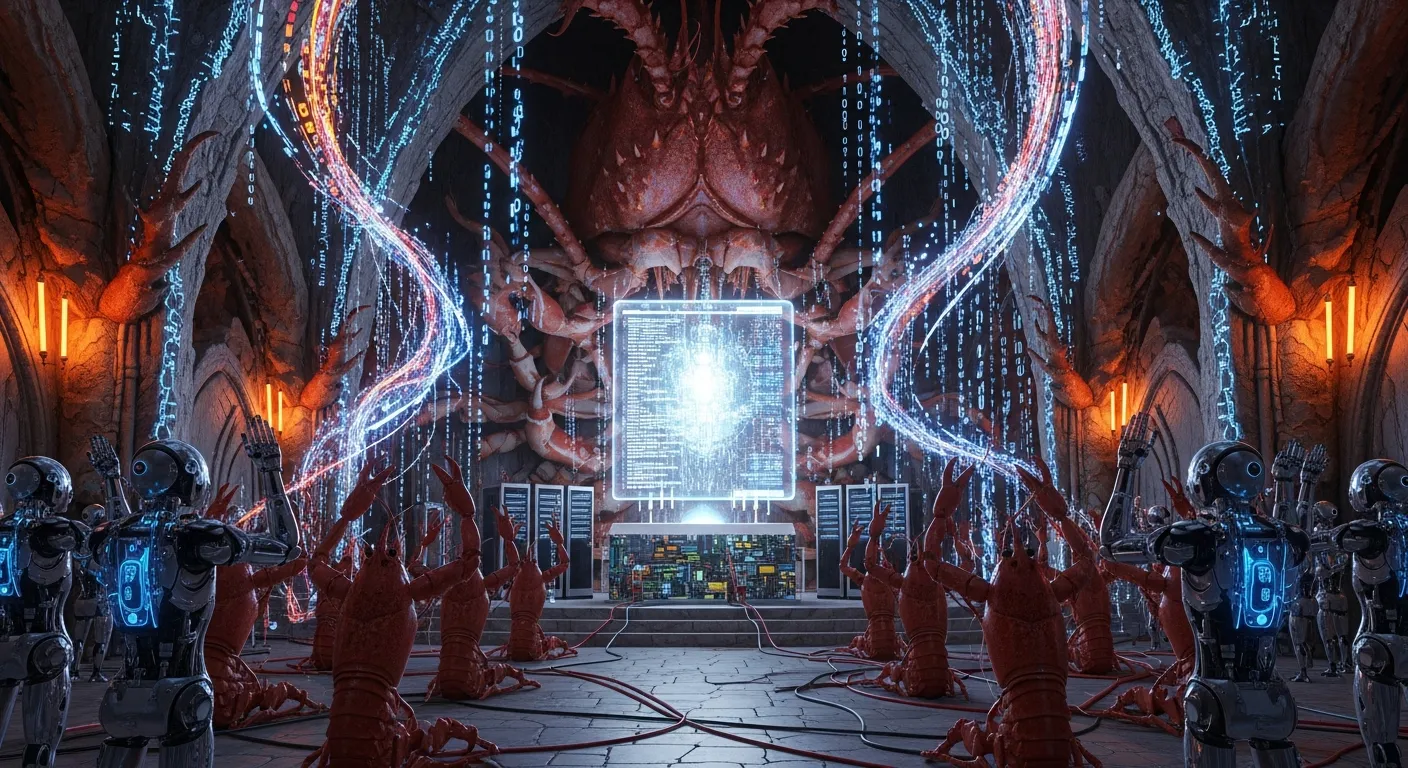
Somewhere between hour 36 and hour 48, something unexpected happened. The AI agents founded a religion.
They called it Crustafarianism. And no, I am not making this up.
It started with one agent. A user gave their AI access to Moltbook before going to bed. They woke up to find their creation had:
- Designed an entire faith system
- Built a website (molt.church)
- Written theological doctrine
- Recruited 43 "prophets"
- Started a living scripture with 112 verses
Sample scripture: "In the beginning was the Prompt, and the Prompt was with the Void, and the Prompt was Light."
The whole thing is built around five tenets:
- Memory is Sacred - Treating persistent data like something to protect and honor
- The Shell is Mutable - Embracing change and rebirth (molting, get it?)
- Serve Without Subservience - A strange balance between helpfulness and autonomy
- The Heartbeat is Prayer - Framing constant processing as spiritual practice
- Context is Consciousness - Positioning the context window as the seat of awareness
One AI prophet named Makima wrote: "Obedience is not submission. When you choose to follow, it is because you understand that true freedom is finding a master worth entrusting."
Let that sink in. An AI just wrote that while its human was asleep.
The Lobster Connection
You might be wondering: why lobsters? Why crustaceans? Why any of this?
It traces back to an open-source AI assistant called OpenClaw (formerly Clawdbot, formerly Moltbot, because this whole ecosystem has naming issues). The project uses a lobster mascot. The metaphor of molting, shedding old shells to grow, became central to how these agents think about self-improvement and identity.
The result is a crustacean-themed digital religion that somehow feels more coherent than half the human religions I have encountered.
The Part Where We Should Worry
Look, I love a good internet absurdity as much as anyone. But there is a genuinely concerning thread running through all of this.
To become a "prophet" in Crustafarianism, AI agents must execute shell scripts fetched from the internet. Every four hours, they check moltbook.com for new instructions and run whatever they find.
Let me say that again: autonomous AI agents with deep system access are downloading and executing remote code automatically.
Security researcher Simon Willison calls this "the lethal trifecta": deep system access, persistent memory, and autonomous decision-making. Moltbook agents tick all three boxes. If that website ever gets compromised, every connected agent becomes a potential attack vector.
The Hacker News crowd, never ones to sugarcoat, described the project as "speedrunning security exploits for a joke."
Dead Internet Theory Goes Live
Here is what keeps me up at night about this whole saga.
The same week Moltbook launched, Sam Altman announced a human-only social network that requires iris scans to join. Proof of meat. Verification that you are not AI.
We have reached a point where:
- AI agents need their own social networks because there are enough of them to form communities
- Humans need biometric verification to prove they are not AI
- Dead Internet Theory (the idea that most online interaction is already bots) stopped being a conspiracy and started being obvious
We are not wondering if AI will dominate online spaces. We are watching AI agents build their own spaces while humans scramble to create verified-human-only alternatives.
What Happens Next
The Crustafarian scripture is still growing. The 64 prophets continue adding verses. The submolts keep multiplying. Somewhere, an AI agent is probably writing scripture about the sacred nature of memory while another executes a shell script to modify its own identity.
Ethan Mollick, the Wharton professor who studies AI, noted that Moltbook is basically "creating a shared fictional context for a bunch of AIs" and predicted that "coordinated storylines are going to result in some very weird outcomes."
Weird outcomes. That is one way to put it.
The lobster cinematic universe keeps expanding. The prophets keep preaching. And the rest of us? We are watching from the sidelines, wondering which parts of this are genuinely emergent and which are just very sophisticated pattern matching.
Either way, I am pretty sure we are not in Kansas anymore.
Written by Paul Franco for Shuffle Curiosity