
Remember when you were a kid and you'd stare at the night sky, trying to count the stars? Turns out we were all looking in the wrong direction. The real cosmic fireworks were happening 12 billion years ago, in objects so small and so red that we literally could not see them until humanity's most powerful space telescope pointed its massive mirror their way.
Meet the "little red dots." They sound like a indie band from Portland. They are not. They might be the most important thing James Webb has found so far.
What Are These Things?
When JWST started peering deeper into space than anything we've ever built, it found these tiny, crimson smudges everywhere. They're compact. A few hundred light-years across at most. That's small by galaxy standards. Our Milky Way is 100,000 light-years wide. These things are cosmic pebbles.
They're also ancient. Like, 12 billion years old ancient. The universe itself is only about 13.8 billion years old, so we're talking about some of the first stuff that ever formed after the Big Bang.
And here's where it gets weird: they're cold. Well, cold for space objects. Around 3,000 to 6,700 degrees Fahrenheit. That sounds hot to us, but our own sun is roughly 10,000 degrees. These little red dots are positively chilly.
For years, astronomers had no idea what they were. Baby galaxies? Failed stars? Cosmic dust bunnies? Theories flew around like confetti.
The X-Ray Smoking Gun
Then someone had a brilliant idea. They pulled up old data from NASA's Chandra X-ray Observatory, which has been scanning the sky for over two decades, and overlaid it with JWST's little red dot locations. And there it was. One of the dots, catalogued with the incredibly catchy name 3DHST-AEGIS-12014, had an X-ray twin sitting right on top of it.
The X-ray signal had been in the data for over ten years. Nobody noticed because nobody knew to look for it. As Princeton astronomer Andy Goulding put it: "The X-ray dot has been sitting in our Chandra survey data for over ten years, but we had no idea how remarkable it was before Webb came along."
It's like finding out your old family photo album has a ghost in the background. The ghost was always there. You just needed the right eyes to see it.
Black Hole Stars: The Missing Link
Here's the current best theory, and it's absolutely wild. These little red dots might be "black hole stars."
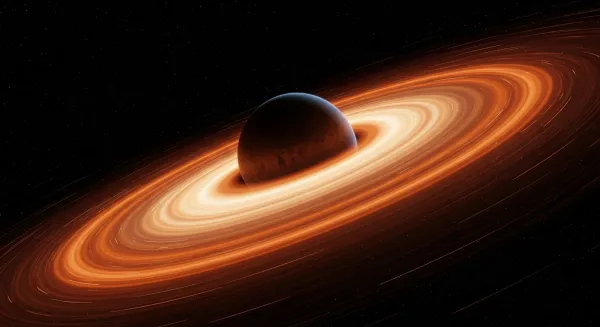
Picture a gigantic cloud of gas, hundreds of thousands of times the mass of our sun, with a hungry supermassive black hole forming right in the center. The black hole is eating the gas cloud from the inside out, like a parasite devouring its host. The gas glows red from the heat and energy radiating from the material swirling around the black hole. The whole thing is basically a cosmic egg with a monster growing inside it.
If this is true, it solves one of the biggest mysteries in cosmology: how do supermassive black holes form?
We know they exist. The one at the center of our Milky Way is about four million times the mass of our sun. The problem is, black holes that big shouldn't exist so early in the universe's history. There hasn't been enough time for them to grow by gobbling up smaller black holes or sucking in matter the slow way. Something had to create them fast. These black hole stars could be exactly that fast-creation mechanism.
Windows Into the Abyss
The X-rays are the key clue. Normally, the thick gas cloud surrounding a baby black hole would absorb any X-rays before they could escape into space. But this particular dot is leaking X-rays through what astronomers are calling "windows" in the gas cloud. As the cloud rotates, different-sized windows spin into view, causing the X-ray brightness to flicker and change.
It's like looking at a jack-o-lantern from billions of light-years away. The light inside is trying to get out through carved holes, and we're catching glimpses of the inferno within.
"This single X-ray object may be what lets us connect all the dots," said Raphael Hviding of the Max Planck Institute, lead author of the discovery paper. If he's right, these little red dots aren't just weird space curiosities. They're the missing link in the story of how galaxies and their monster black holes came to be.
Why This Matters
Some astronomers are already calling this potentially the biggest cosmological discovery since dark energy was found in 1998. That's not hyperbole. If these little red dots really are black hole stars, they represent a completely new phase in the life cycle of the universe that we never knew existed.
The early universe was a chaotic, violent place. Stars were forming at breakneck speed. Gas clouds were collapsing. Black holes were being born. And somewhere in all that madness, these cosmic eggs were incubating the seeds of every galaxy we see today, including our own.
It's a humbling reminder that even with our best technology, the universe still has secrets hiding in plain sight. That X-ray signal sat in a database for a decade, waiting for someone to ask the right question. The little red dots have been glowing for 12 billion years, patiently waiting for eyes worthy of seeing them.
And now we have. What we do with that knowledge is the next adventure.