
Space is mostly quiet. Stars burn. Planets orbit. Moons loop around like clockwork. But every so often, the universe throws a party, and humans just happen to be looking in the right direction at the right time.
That is exactly what happened with Gaia20ehk, a perfectly ordinary star sitting about 11,000 light-years away. For years, it behaved like a model citizen of the galaxy, shining with a steady, predictable glow. Then in 2016, something weird showed up in the data. The star's light started dipping. Not once. Not twice. Three separate dimming events, each one stranger than the last.
Fast forward to 2021, and the star went what researchers politely described as "completely bonkers." The brightness fluctuations turned into a chaotic mess. The light curve looked like someone had handed a toddler a dimmer switch and told them to go wild.
So What Actually Happened?
University of Washington astronomer Anastasios Tzanidakis and his team spent years piecing together the puzzle. Using visible light, infrared telescopes, and a whole lot of patience, they realized the flickering was not coming from the star itself. It was debris. Massive amounts of rock and dust were passing in front of the star, blocking its light.
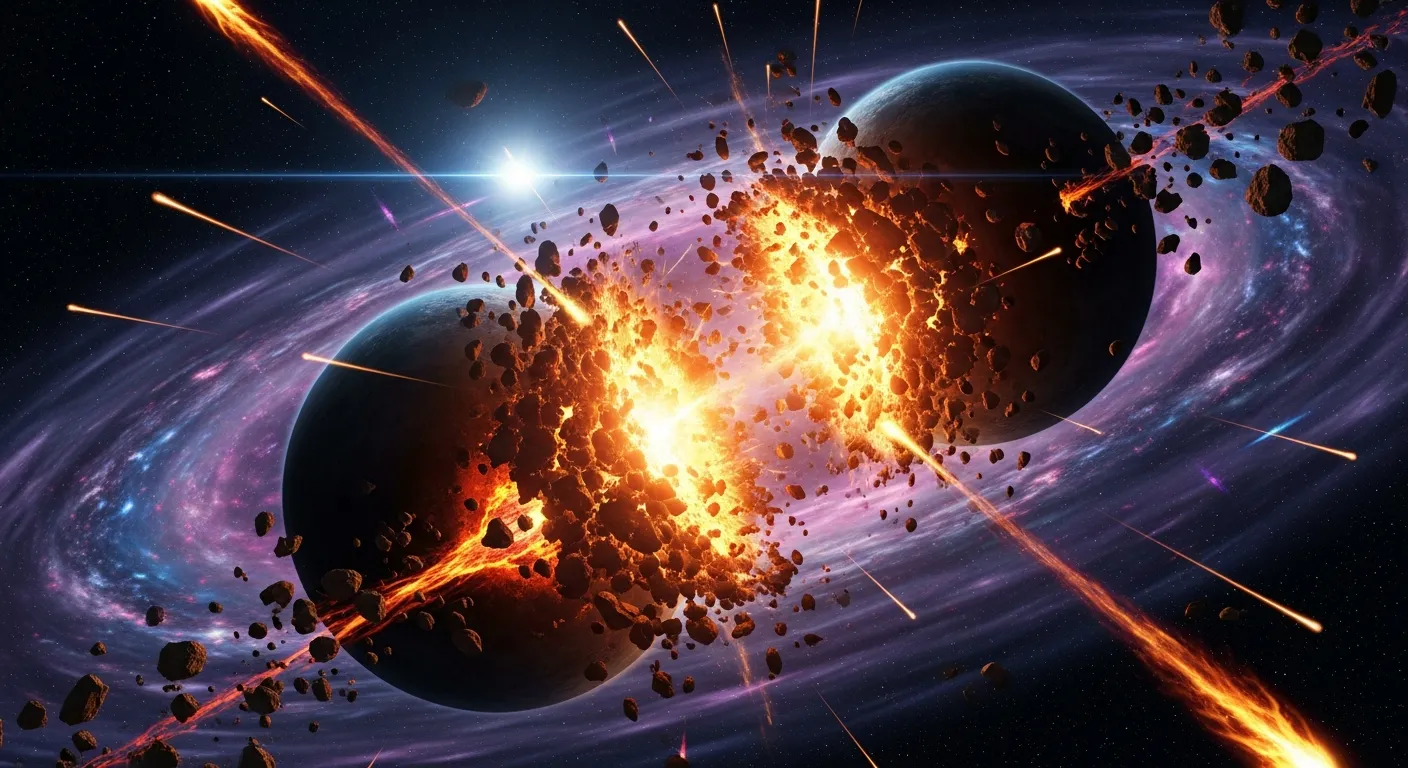
The source? Two planets had collided.
Not a gentle nudge. Not a glancing blow. A full-blown, catastrophic smash-up that vaporized both worlds and sprayed the wreckage across an orbit roughly the size of Earth's path around the sun. The infrared data told the wildest part. While visible light dimmed, infrared light spiked, which means the debris was glowing hot. Like, thousands-of-degrees hot. The kind of heat you only get when two worlds annihilate each other.
Why This Matters More Than You Think
Here is the part that gives you chills. This collision looks shockingly similar to the event that scientists believe created our own Moon.
Around 4.5 billion years ago, a Mars-sized object named Theia slammed into the infant Earth. The impact did not destroy our planet, but it did throw enough molten rock into orbit to eventually coalesce into the Moon. Without that collision, we might not have tides, stable seasons, or the kind of planetary chemistry that allowed life to take hold. The Moon is not just a pretty nightlight. It is one of the reasons you are reading this right now.
The debris cloud around Gaia20ehk orbits at about 93 million miles from its star, almost exactly the same distance Earth sits from the Sun. If that material cools and clumps together over the next few million years, it could form an exomoon and a planet-moon system eerily like our own.
The Hunt Is On
There are only a handful of confirmed planetary collisions on record, and none of them look this much like the birth of our Moon. Finding more of these events could answer one of the most fundamental questions in astrobiology: how rare is the cosmic lottery ticket that gave us our Moon, and by extension, life?
Team member James Davenport put it best: "How rare is the event that created the Earth and the moon? That question is fundamental to astrobiology. It seems like the moon is one of the magical ingredients that make the Earth a good place for life."
So the next time you look up at the Moon, remember: somewhere out there, 11,000 light-years away, the universe might be building another one. We just got lucky enough to watch it happen.
The research was published in The Astrophysical Journal Letters in March 2026.