
Here is a very specific kind of cosmic drama that astronomers love: something in the sky is quietly falling apart, and nobody noticed until the debris started hitting Earth.
That is basically what just happened with a newly identified meteor stream called the 87-Virginids. Scientists now think it comes from an asteroid that is slowly disintegrating as it swings too close to the Sun, turning itself into a dusty trail that occasionally lights up our atmosphere as meteors.
Which means we may be watching a space rock die in real time.
Not Quite a Comet, Not Quite a Normal Asteroid
Usually, when you think of meteor showers, you think of comets. A comet gets heated by the Sun, ice and dust boil off, and Earth later plows through that trail. Easy enough.
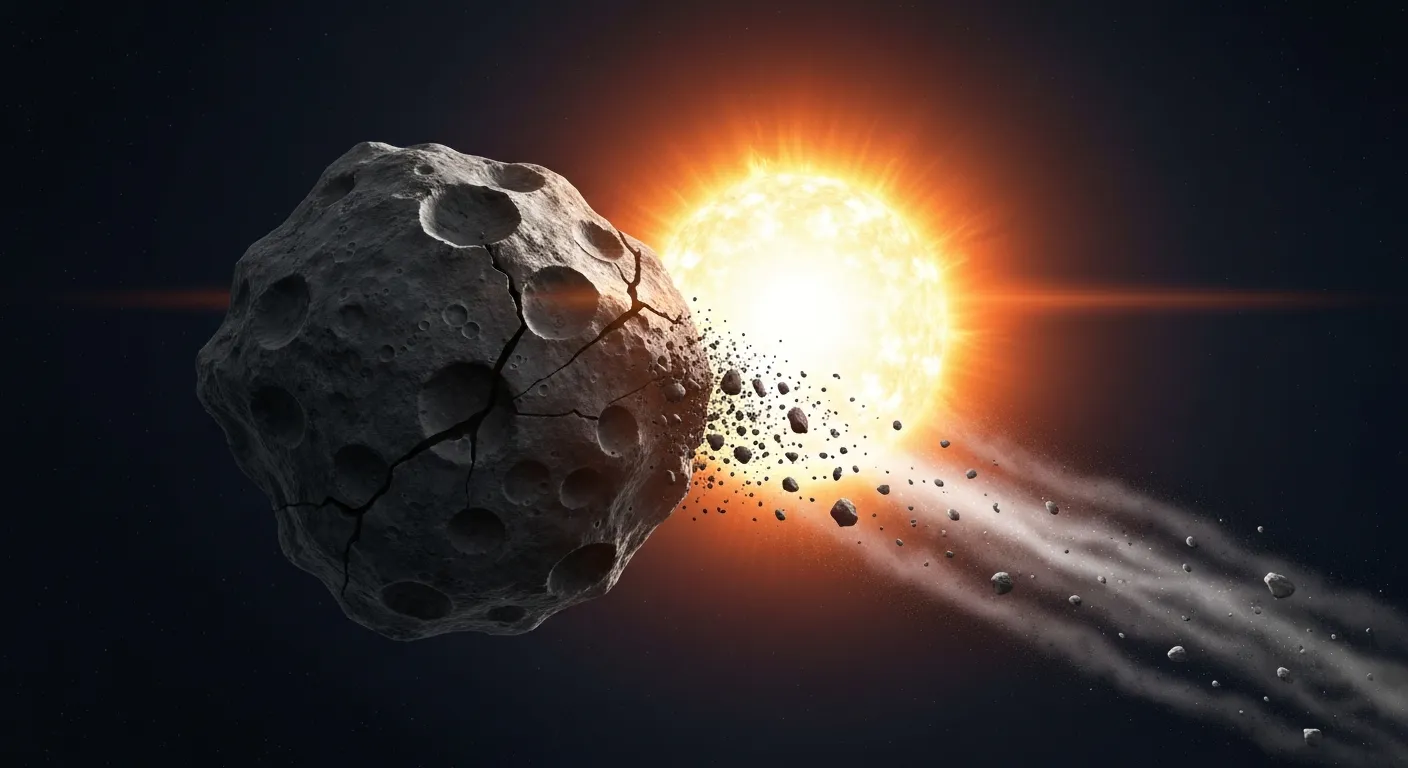
But this case is stranger. The 87-Virginids do not appear to come from a classic icy comet. Instead, they seem to come from an asteroid, a rocky object, that is being slowly broken down by extreme solar heating.
That makes it part of a weird little category of objects astronomers sometimes call rock comets. They are not spraying out beautiful icy tails like the comets in storybooks. They are getting cooked, cracked, and pulverized by the Sun until bits of them drift away into space.
The most famous example is Phaethon, the object linked to the Geminid meteor shower. Now the new 87-Virginids may represent only the second known case of this kind of asteroid-fed meteor stream. That alone makes the discovery a big deal.
How They Found It
The discovery did not begin with some giant dramatic telescope image of an asteroid exploding. It started the way a lot of good astronomy starts now: with automated sky cameras, data, and a lot of patient pattern matching.
Researchers analyzing meteor detections noticed that a small cluster of meteors appearing in the direction of Virgo seemed to share the same orbital fingerprint. That suggested they were not random shooting stars, but fragments from the same parent body.
Trace that orbit backward and the culprit appears to be an asteroid on a Sun-skimming path, one that gets hot enough for the surface to break down over time. Every close pass can shake off more material. Over many orbits, that rubble spreads into a stream. And when Earth crosses part of it, the particles burn up overhead.
It is less like a single explosion and more like a long, dusty death.
Why the Sun Is So Good at Breaking Things
If you drop a rocky asteroid into the outer solar system, it mostly just remains a rock. But move it close enough to the Sun and the rules get ugly.
The surface heats intensely during the day, then cools again as conditions change. That repeated thermal stress can crack rock apart. Minerals expand and contract. Dust gets liberated. In extreme cases, sodium and other volatile elements can help kick material loose. The result is a slow-motion crumbling process powerful enough to create an entire meteor stream.
So while comets are famous for sublimating ice, these near-Sun asteroids may be disintegrating through heat damage alone. Same outcome in the sky. Very different physics.
Why This Matters
On one level, this is just cool. A new meteor stream is fun. An asteroid dying near the Sun is fun. Space rocks with identity issues are fun.
But the science matters too.
First, it tells astronomers that the inner solar system is still dynamically messy. Small bodies are not just relics from the early solar system sitting around unchanged. Some of them are actively evolving, shedding material, and maybe even disappearing entirely.
Second, it helps explain where certain meteor streams come from. For years, some showers have looked like they should have a comet parent, but none was obvious. These newly recognized rock-comet systems give astronomers another mechanism to work with.
Third, it sharpens our understanding of what happens to near-Earth objects on extreme orbits. If heat can slowly dismantle an asteroid, then the population of Sun-grazing objects may be more fragile, and more temporary, than we assumed.
A Cosmic Crime Scene
There is something delightful about the logic of this discovery. Scientists did not catch the asteroid in the act first. They saw the glowing crumbs in Earth’s atmosphere, then worked backward to identify the thing that must have dropped them.
It is astronomy as forensic science. The meteors are the evidence. The orbit is the fingerprint. The dying asteroid is the suspect.
And the suspect is sitting dangerously close to the biggest furnace in the solar system.
The Bigger Picture
The solar system often looks stable from a distance. Planets loop around neatly. The same constellations return. Meteor showers show up on schedule. But under the hood, it is all constant breakage, collision, erosion, and decay.
Moons get battered. Rings lose material. Comets evaporate. Asteroids collide. And now we have another reminder that even a chunk of rock can live a temporary life if it wanders too close to the Sun.
That is what makes the 87-Virginids discovery so good. It takes something that sounds static, an asteroid, and reveals it as a process instead of an object. Not a rock. A rock in the middle of becoming dust.
Which is, honestly, a very solar-system way to die.
Sources: discovery reports published May 2026 on the newly identified 87-Virginids meteor stream and its likely Sun-heated asteroid parent; coverage from major science outlets following the announcement.