
Published in Science on May 21, 2026. This is the kind of headline that makes astronomers lose sleep.
Somewhere in the darkest, earliest corners of the universe, a monster star just blew itself apart. Not a regular supernova. Not even a particularly bright one. This was something else entirely: a pair-instability supernova, the kind of cosmic detonation so violent it leaves absolutely nothing behind. No black hole. No neutron star. Just a cloud of freshly forged elements expanding into the void, and a brief, brilliant flash of light that traveled for 13 billion years before hitting a telescope parked a million miles from Earth.
At least, that is what Andrea Ferrara and his team at Scuola Normale Superiore think they have found. Their new paper, published in Science this week, argues that a mysterious flickering dot in a JWST deep field image is not a galaxy at all. It is the death scream of a Population III star: one of the very first stars ever born, made of nothing but primordial hydrogen and helium, burning hundreds of times brighter than our Sun, and finally tearing itself apart in an explosion powered by its own photons.
What Is a Pair-Instability Supernova, and Why Should You Care?
Most supernovae happen when a star runs out of fuel and its core collapses. A pair-instability supernova is different. It happens to truly enormous stars, between about 140 and 260 times the mass of our Sun, back when the universe was young and metal-free.
Inside these monsters, the core gets so hot that gamma-ray photons start spontaneously converting into electron-positron pairs. Yes, the star literally turns light into matter. This process saps the core's outward radiation pressure, triggering a runaway thermonuclear explosion that blows the entire star to smithereens. Not a chunk. Not a core. The whole thing. The energy released can be up to 100 times a normal supernova.
If Ferrara's team is right, this would be the first direct detection of a Population III star. Ever. These stars have been theoretical predictions for decades. We know they must have existed. Without them, there would be no carbon, no oxygen, no iron in the universe. But we have never actually seen one. They formed so early and died so fast that they vanished before telescopes existed.
The Flickering Dot That Should Not Exist
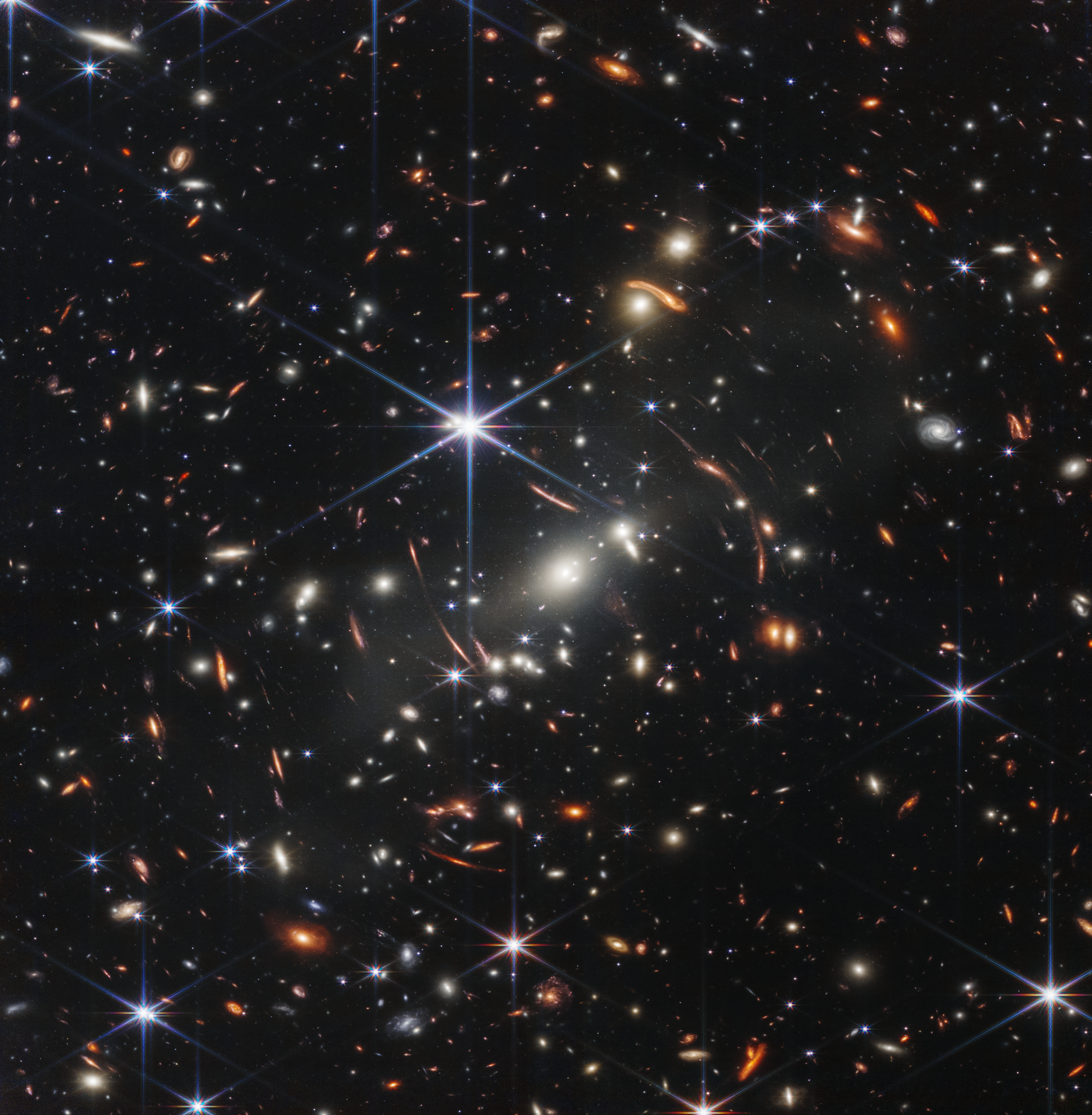
The object in question is an ultra-high-redshift candidate called Capotauro. JWST spotted it in the CEERS survey, and it looked like a galaxy candidate sitting at roughly redshift 30, meaning we would be seeing it when the universe was only about 100 million years old. That is already wild enough. But here is where it gets weird: when JWST looked again, the dot had brightened. By about 20 percent.
Galaxies at that distance do not brighten measurably over 800 days. Stars exploding, on the other hand, absolutely do.
Ferrara's team ran the numbers. They compared Capotauro's light curve against theoretical pair-instability supernova models from the Max Planck Institute's supernova archive. The best fit? A helium-core star of roughly 250 solar masses, exploding at redshift 15, which puts it about 13 billion light-years away. The light we are seeing today left that explosion when the universe was barely a teenager.
Why This Might Actually Be Real
The paper is careful. The authors lay out exactly what would confirm or kill this hypothesis. First, more observations need to confirm the variability is real and matches the predicted light curve of a PISN. Second, deeper MIRI photometry should show the spectrum continuing to rise in the mid-infrared, which a brown dwarf would not do. Third, follow-up spectroscopy could spot the telltale absorption features of freshly synthesized magnesium and iron in the expanding ejecta.
There is a competing theory: Capotauro could be a very cold brown dwarf in our own galaxy. The spectrum fits that too. But brown dwarfs do not get 20 percent brighter over two years. So the variability is the smoking gun.
The Bigger Picture
JWST has been finding bright objects in the early universe faster than theory predicted. Population III stars have been the missing piece of that puzzle. These stars would have been hundreds of times more massive than the Sun, blazing through their hydrogen in just a few million years, then dying in spectacular explosions that seeded the first galaxies with heavy elements.
Finding one would not just be a cool discovery. It would confirm how the first heavy elements were forged. It would tell us whether the early universe really did make these absurdly giant stars. And it would give us our first actual look at the engines that built the periodic table.
Astronomers have scheduled more JWST time to watch Capotauro fade. If the light curve continues to match the PISN prediction, and if spectroscopy picks up those freshly minted elements, the first star ever observed might also be the most distant supernova ever recorded. Not a bad way to go out.
Sources: