
A tiny, invisible galaxy magnified 100 times by a cosmic lens is the most chemically primitive ever found. It could finally bridge the gap to the first stars.
Here is a thing you did not expect to read today: astronomers have found a galaxy that, by all rights, should not exist. It is so faint, so small, and so chemically impoverished that it is basically invisible to our best telescopes. And yet, thanks to a 4.3-billion-year-old natural magnifying glass floating through space, the James Webb Space Telescope just spent over 30 hours staring at it, and what it found might rewrite our understanding of how the universe began.
The Invisible Galaxy
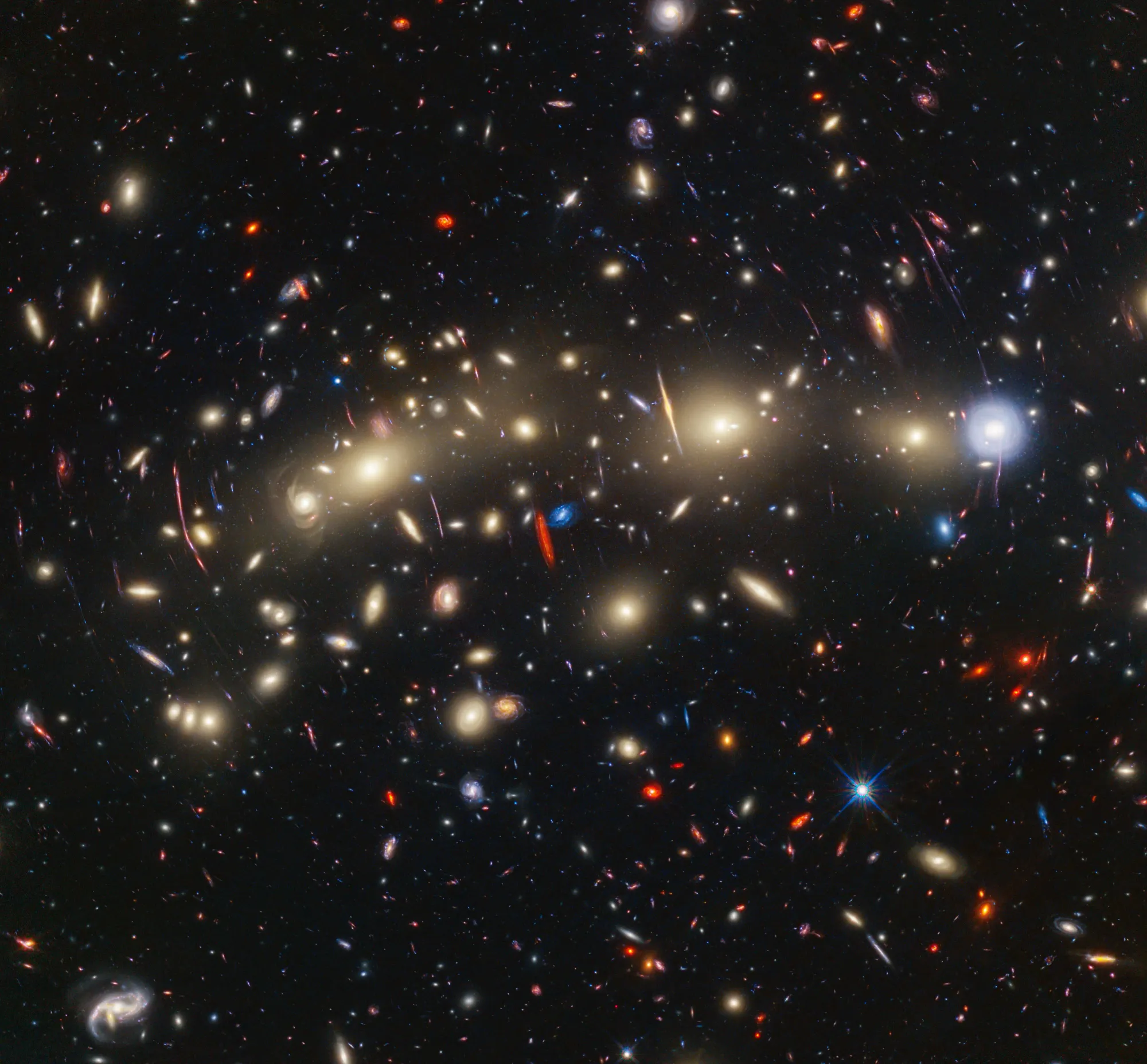
The object in question is LAP1-B, a tiny blob of light located behind a massive galaxy cluster called MACS J0416. The cluster acts like a cosmic lens, bending and magnifying the light of anything behind it. In this case, that magnification factor is roughly 100x. Without that lucky alignment, LAP1-B would be completely undetectable.
But even magnified, the galaxy is bizarre. Its oxygen abundance is about 1/240th that of our Sun. To put that in perspective: the Sun has about 2% oxygen by mass. LAP1-B has 0.008%. It is, to date, the most chemically primitive galaxy ever identified at any epoch in the universe.
"I was instantly thrilled by the extreme lack of oxygen," says Kimihiko Nakajima of Kanazawa University, who led the study. "Finding a galaxy in such a primitive state is astonishing. It is a chemical signature that clearly indicates a primordial galaxy caught in the moments shortly after its formation."
A Snapshot of Cosmic Dawn
LAP1-B sits at a redshift of z = 6.625, which means we are seeing it as it was roughly 800 million years after the Big Bang. The universe was still young. Stars had only recently begun fusing hydrogen into heavier elements like carbon and oxygen. And somehow, this galaxy got almost none of them.
Here is where it gets weird: the galaxy also has a surprisingly high carbon-to-oxygen ratio. That specific pattern matches what theorists predict from the explosions of the universe's very first stars, so-called Population III stars. These were massive, metal-free giants that lived fast, died young, and scattered their ashes across the cosmos.
The team also found that LAP1-B is incredibly lightweight. Its stellar mass is less than 2,700 times the mass of our Sun. That is basically nothing in galactic terms. But the total mass of the galaxy, inferred from the motion of its gas, is closer to 10 million solar masses. Meaning: over 99% of this galaxy's mass is invisible dark matter.
The Missing Link
This discovery matters because astronomers have long suspected that the tiny, ancient "fossil" galaxies orbiting our Milky Way, called Ultra-Faint Dwarfs (UFDs), are the leftover remnants of the universe's first galaxies. The problem was proof. No one had ever caught one in the act of forming.
"UFDs are not only the faintest galaxies; they are composed of ancient stars over 12 billion years old and are often described as fossils of the Universe," says Masami Ouchi of the National Astronomical Observatory of Japan. "Astronomers suspected they might be the remains of the Universe's earliest galaxies because they lack heavy elements, but astronomers never had a direct link, until we found LAP1-B."
Why This Feels Like Time Travel
Think about what we are actually doing here. We are looking at a galaxy that formed when the universe was a toddler. It is so primitive that it barely has any "metals" (in astronomy, anything heavier than helium counts as a metal). It is so dark matter dominated that the stars are basically an afterthought. And it is so small that, without the cosmic lens, we would never have known it existed.
Yet it is real. We have its spectrum. We know its chemistry. We can measure how fast its gas is swirling. It is not a simulation. It is not a theory. It is a postcard from the edge of everything.
The best part? This is just the beginning. The DREAMS program ("Deep Reconnaissance of Early Assemblies of Metal-poor Star formation") that found LAP1-B is continuing to scour the early universe for even more primitive objects. The first galaxies ever formed are out there, waiting. And for the first time in history, we might actually find them.