
Here is a thing you probably did not expect to read today: Venus, the scorched hell-planet next door, is home to the largest hydraulic jump in the solar system. And it is made of sulfuric acid.
If your first thought is "what is a hydraulic jump?"—fair. Your second thought is probably "why does a planet have one?" Even fairer. But the answer is genuinely one of the most unexpectedly delightful discoveries in recent planetary science, and it involves a phenomenon you can recreate in your kitchen right now.
Turn On Your Tap. Seriously.
Go to your sink. Turn on the water. Notice how the stream hits the basin, spreads out in a thin, fast-moving ring, then suddenly slows down and gets deeper? That sudden transition—from thin and fast to thick and slow—is a hydraulic jump. It happens because the flowing fluid cannot maintain its speed as the area expands, so it piles up. It is fluid dynamics 101, and it is happening in your sink every single day.
Now imagine that same phenomenon. But instead of water in a ceramic basin, it is carbon dioxide and sulfuric acid vapor in an atmosphere so crushing that the surface pressure is 92 times what you feel right now. Instead of a few inches across, it is 3,700 miles long. Instead of a few millimeters high, it is 30 miles tall. And instead of water, it is a churning wall of sulfuric acid clouds sweeping around an entire planet every few days.
That is what JAXA's Akatsuki spacecraft discovered around Venus in 2016, and it has taken scientists nearly a decade to figure out what they were actually looking at.
The Cloud That Should Not Exist
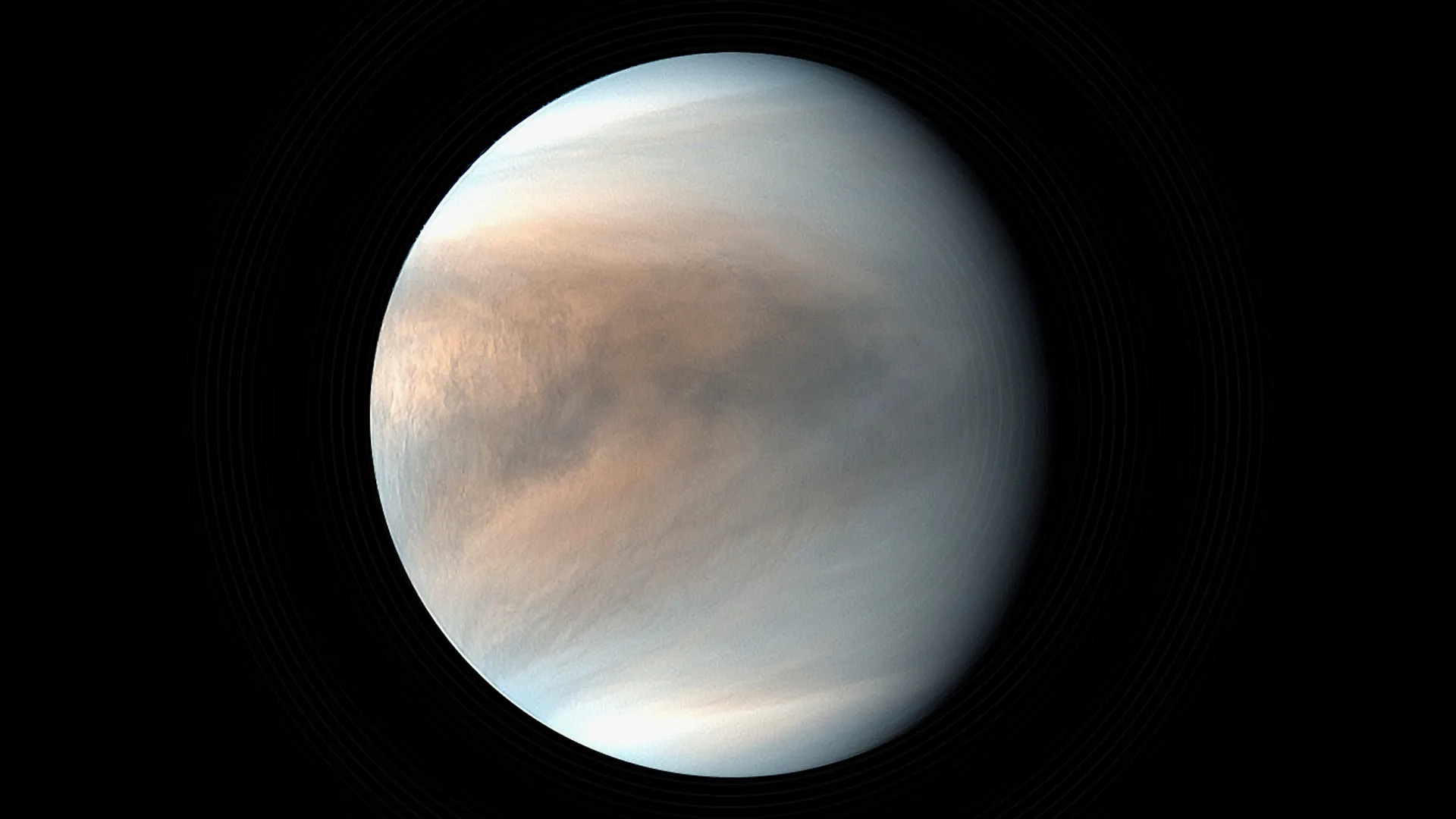
When Akatsuki arrived at Venus, it spotted something weird: an enormous bank of clouds sitting about 31 miles up in the atmosphere, aligned perfectly with the planet's equator. It was fast. It had a bizarrely sharp leading edge. And at roughly 3,700 miles across, it was way too big to be a normal weather pattern.
For years, nobody could explain it. Venus already has one of the strangest atmospheres in the solar system—96.5% carbon dioxide, surface temperatures hot enough to melt lead, and winds that whip around the planet in just four Earth days even though the planet itself takes 243 days to rotate once. Scientists had models. They had simulations. None of them predicted a cloud wall the size of an ocean.
Then a team led by Takeshi Imamura at the University of Tokyo sat down with the math. And the answer turned out to be sitting in everybody's kitchen.
Kelvin Waves and Acid Fountains
Here is how it works. Not too far above Venus's scorched surface, an enormous atmospheric wave propagates eastward along the equator. On Earth we call these Kelvin waves, and they show up in both the atmosphere and the ocean. They are planetary-scale features, meaning they span thousands of miles. Venus's version is no exception.
As this Kelvin wave moves, it eventually slows down. That slowdown triggers a hydraulic jump. The sudden deceleration forces a massive updraft of sulfuric acid vapor to rocket upward—about 31 miles up, to be exact—where it cools and condenses into a terrifyingly huge bank of sulfuric acid clouds. The cloud bank then trails behind the Kelvin wave like a comet tail, sweeping around the planet in a never-ending cycle of planetary-scale sink physics.
"We're now able to show that this cloud disruption is caused by the largest known hydraulic jump in the solar system," Imamura said in a statement. "Our discovery of the hydraulic jump on Venus connecting a very large-scale horizontal process with a strong localized vertical wave is unexpected, as in fluid dynamics these are usually disconnected."
Why This Actually Matters
It is easy to chalk this up as a fun fact. "Hey, Venus has a giant kitchen sink phenomenon!" But the discovery has real scientific weight.
For one, this is the first confirmed hydraulic jump on any planet besides Earth. That makes Venus a natural laboratory for studying fluid dynamics under extreme conditions. The fact that it behaves in unexpected ways is a reminder that atmospheric physics on other worlds can diverge wildly from what we know at home.
More practically, this plugs a major gap in Venusian climate models. "Up until now, we used a global circulation model for Venus that is similar to Earth's, but this model doesn't include the hydraulic jump that we have now identified," Imamura explained. Future simulations will need to account for this effect, which means our understanding of Venus's dense atmosphere just took a significant step forward.
And yes, there are implications for exoplanets too. If a phenomenon this extreme can hide on our nearest planetary neighbor for decades, what else are we missing on worlds orbiting distant stars?
The Universe Is Weirder Than Your Sink
There is something almost poetic about this discovery. The same physics that governs your bathroom faucet also sculpts a 30-mile-high wall of acid on a world 25 million miles away. It is a reminder that the universe does not separate the cosmic from the mundane. The laws of fluid dynamics scale from millimeters to thousands of miles without breaking a sweat.
Venus has spent most of its career as the solar system's neglected sibling—too hot for rovers, too hostile for humans, overshadowed by Mars and the outer planets. But discoveries like this one keep pulling it back into the spotlight. Somewhere beneath those sulfuric acid clouds, the planet is still keeping secrets. And some of them, apparently, are hiding in plain sight.
Right next to your kitchen sink.
Sources: University of Tokyo; JAXA Akatsuki mission; Journal of Geophysical Research — Planets, April 2026.