
If you enjoy the very specific genre of space news called "well that was close", this week delivered. A newly discovered asteroid named 2026 JH2 just zipped past Earth at only about 91,000 kilometers away, which is roughly 24 percent of the distance to the Moon. In cosmic terms, that is not just nearby. That is the celestial equivalent of someone speed-walking through your living room and apologizing on the way out.
The wildest part is not that the asteroid passed close to Earth. Small objects do that more often than most people realize. The wildest part is that astronomers only found this one on May 10, just days before its closest approach on May 18.
Wait, how big was this thing?
Estimates put 2026 JH2 somewhere around 15 to 30 meters wide, depending on how reflective its surface is. That is a frustratingly big range, but asteroid sizing works like that when you first spot one. A brighter object might be small and shiny, or larger and darker. Until infrared measurements or radar data show up, astronomers are basically solving a very high-stakes rock riddle.
At the lower end, it is in the same rough size class as the Chelyabinsk meteor that exploded over Russia in 2013. At the upper end, it starts feeling a lot less cute. The good news is simple: this one was never going to hit us. It passed safely by.
Why we barely saw it coming
This is the real story. Richard Binzel at MIT pointed out that bus-sized asteroids pass through our neighborhood several times per year. The difference now is that our surveys are finally getting good enough to catch more of them before they slip by unseen.
That sounds reassuring, and it is, mostly. But it is also a reminder that space is full of small, fast-moving stuff, and our inventory is still incomplete. UCLA planetary scientist Jean-Luc Margot noted that astronomers have observed only a tiny fraction of near-Earth asteroids in this size range. So when one pops up a few days before a flyby, that is not a shocking failure. It is almost expected.
In other words, Earth is not suddenly under asteroid siege. We are just getting better at noticing the pebbles that have been whizzing past the porch the whole time.
The fun part: you could actually watch it
This was not one of those giant Hollywood asteroids with a flaming tail and a Bruce Willis subplot. At peak brightness, 2026 JH2 reached about magnitude 11.5, which means you needed a small telescope and dark skies, not superhero vision. The Virtual Telescope Project even streamed part of the flyby live, which is a delightful internet-age sentence. A random chunk of rock from the solar system's leftovers bin got its own livestream.
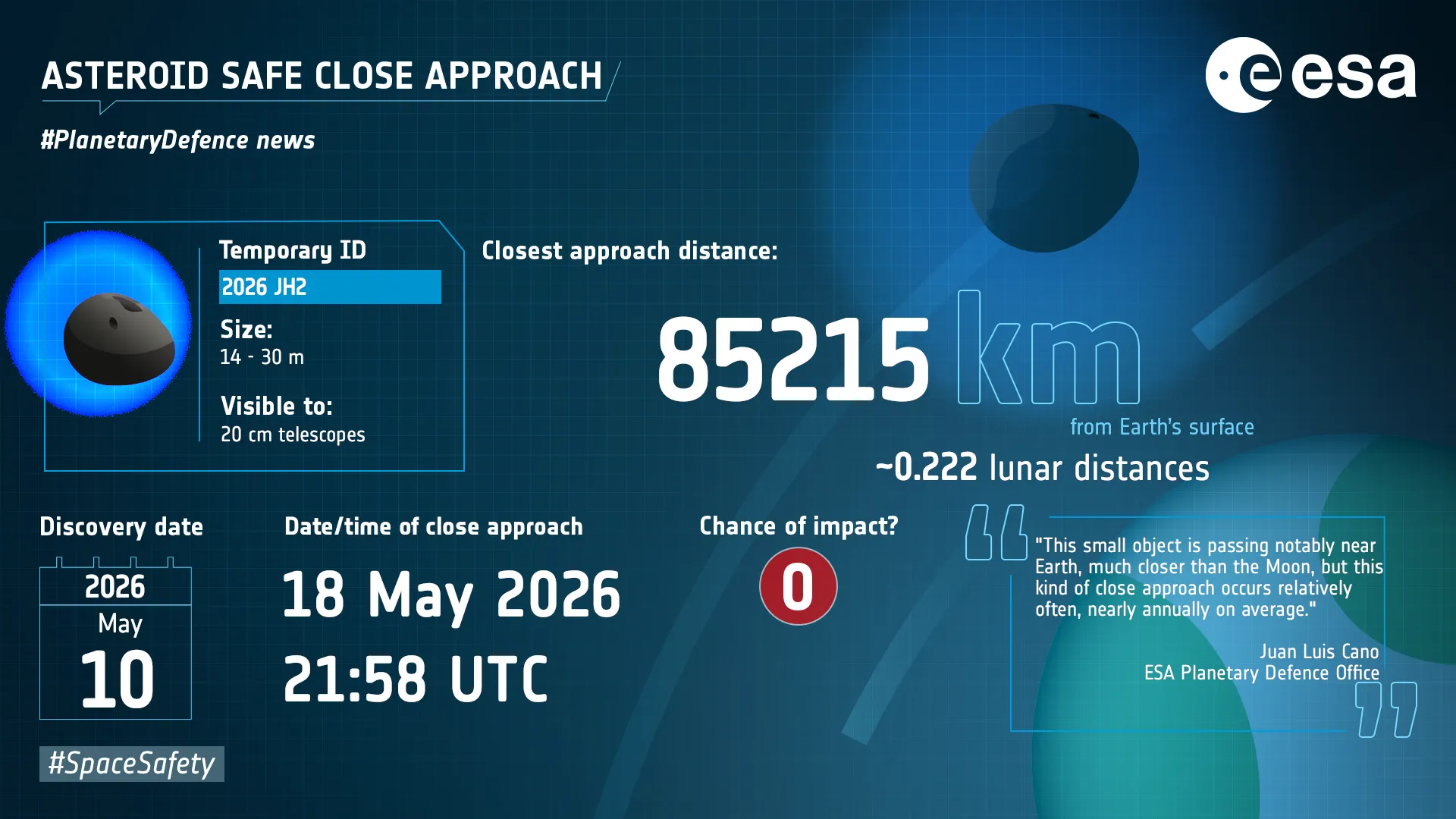
ESA also published a lovely close-approach visual showing just how deeply this little rock dipped into Earth's orbital neighborhood. It is the kind of graphic that makes you instinctively sit up a little straighter.
The bigger cosmic takeaway
Stories like this are a weird mix of humbling and comforting. Humbling, because the solar system is still tossing debris around like it forgot to clean up after formation. Comforting, because the people tracking this stuff are getting better, faster, and much more coordinated across telescopes, databases, and survey teams.
Also, asteroid 2026 JH2 is a nice preview of something far bigger on the horizon: Apophis, the famous asteroid that will make an even closer and much more dramatic pass in 2029. That one will actually be visible to the naked eye from parts of Earth, which feels unfairly cool.
For now, 2026 JH2 gets to wear the crown for Most Stressful Harmless Visitor of the Week. It came in fast, passed inside the Moon's orbit, reminded us that our planet lives on a slightly chaotic shooting gallery, and left without breaking a thing.
That is honestly the best kind of space drama.
Source trail: ESA's May 18 close-approach update and image for asteroid 2026 JH2, coverage from CNN based on NASA JPL and expert comments, plus the Virtual Telescope Project's observation notes and livestream announcement.