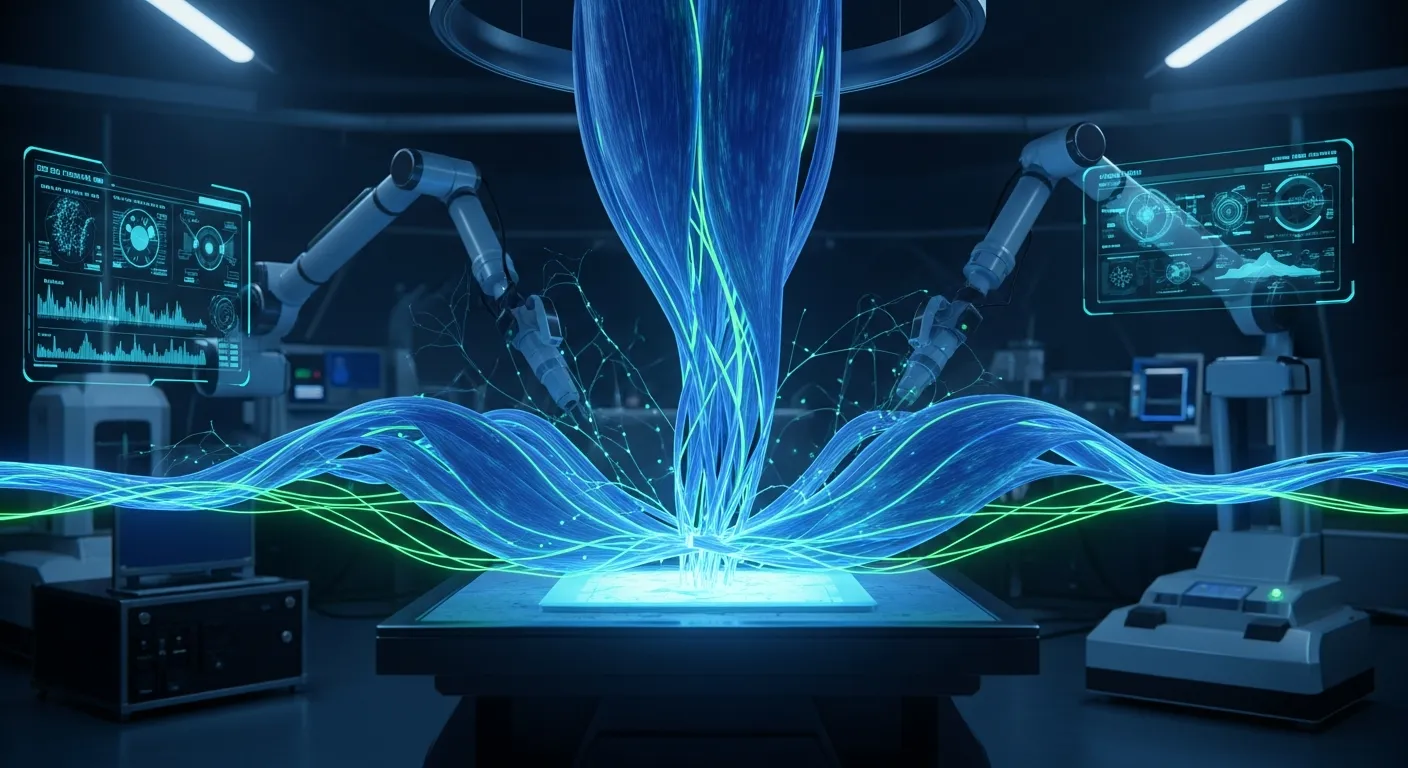

What if your body could grow its own spare parts?
Not with metal. Not with plastic. But with you. Actual living tissue that becomes hardware.
That sci-fi plot just became reality. MIT engineers have developed a myoneural actuator (MNA) that hijacks your own muscles and turns them into biological motors. These living implants can restore movement to paralyzed organs, and they are already working in animal trials.
The Problem No One Solved
Paralyzed organs are devastating. Spinal cord injuries can leave a bladder unable to empty. Crohn's disease can freeze your intestines. Today, your options are grim: mechanical implants that break, or transplants that require lifelong immune suppression.
Scientists have tried building artificial muscles in labs. They have tried miniaturizing mechanical actuators. Both approaches hit walls. Lab-grown muscle takes forever to build cell by cell. Mechanical parts fatigue, fail, and your body rejects foreign materials.
MIT tried something completely different.
Hijacking Nature's Wiring
Here is where it gets wild.
The team realized they did not need to build new muscle. They could reprogram muscle you already have.
The trick was the nervous system. Motor neurons are controlled by your brain. Stimulate them, and your brain gets involved. That is bad if you want automatic organ function.
But sensory neurons are different. They are wired to receive signals, not command them. The team wondered: what if we made sensory nerves control muscle instead?
They swapped motor nerves for sensory ones in rodent muscle. The result? The sensory nerves reconnected and formed functional synapses. The muscle lit up. But here is the kicker: sensory neurons made the muscle 260% more fatigue-resistant.
Why? Motor neuron axons vary wildly in size. When stimulated, the biggest fire first and exhaust the muscle fast. Sensory axons are nearly uniform, so signals spread evenly. Same muscle, completely different endurance.
A Living Motor That Talks Back
The MNA is not just a motor. It is a two-way communication system.
When wrapped around a paralyzed rodent intestine, the MNA restored squeezing motion. In another experiment, it controlled calf muscles simulating human amputation cases.
Most importantly, it transmitted sensory signals back to the brain.
Think about that. A paralyzed stomach could feel hunger again. A reconstructed skin graft could sense touch, temperature, pressure. Prosthetics that actually feel.
The system uses a digital controller as the command center, bypassing damaged brain pathways entirely. Your computer becomes the new brain for that muscle.
The Surgery Is Already Routine
Implanting this thing does not require some futuristic procedure. It uses surgeries already common in hospitals. That matters for regulatory approval and real-world adoption.
No foreign materials. No batteries to replace. No charging stations. Just living tissue doing what living tissue does best: healing, adapting, persisting.
Where This Gets Really Weird
The researchers are already dreaming bigger.
Skin grafts wrapped with MNAs could restore tactile feedback for prosthetic users. Virtual reality could become actually immersive, letting you feel what your digital avatar touches.
Our research is on the brink of giving new life to various parts and extensions of the body, says co-lead author Guillermo Herrera-Arcos. It is exciting to think that our system could enhance human potential in ways that once only belonged to the realm of science fiction.
Senior author Hugh Herr, who co-directs MIT's bionics center, calls this a category of medicine different from anything seen in clinic.
He is not exaggerating. This is medicine where your own body becomes the technology.
The Bottom Line
We are entering an era where the line between biology and machine dissolves. Not by replacing tissue with metal, but by teaching tissue new tricks.
Your muscles as motors. Your nerves as controllers. Your body as hardware.
The future is not implants. It is upgrades.
Category: Health | Author: Paul Franco