
Forget everything you thought you knew about genetics. While the rest of us are stuck with the DNA we're born with, octopuses have figured out how to hack their own genetic code in real-time. And honestly? It's the coolest thing in biology right now.
Here's the wild part: most animals, including humans, have pretty straightforward genetic systems. DNA gets copied to RNA, RNA makes proteins, done deal. But octopuses? They looked at this system and said "nah, we can do better."
The Ultimate Genetic Remix
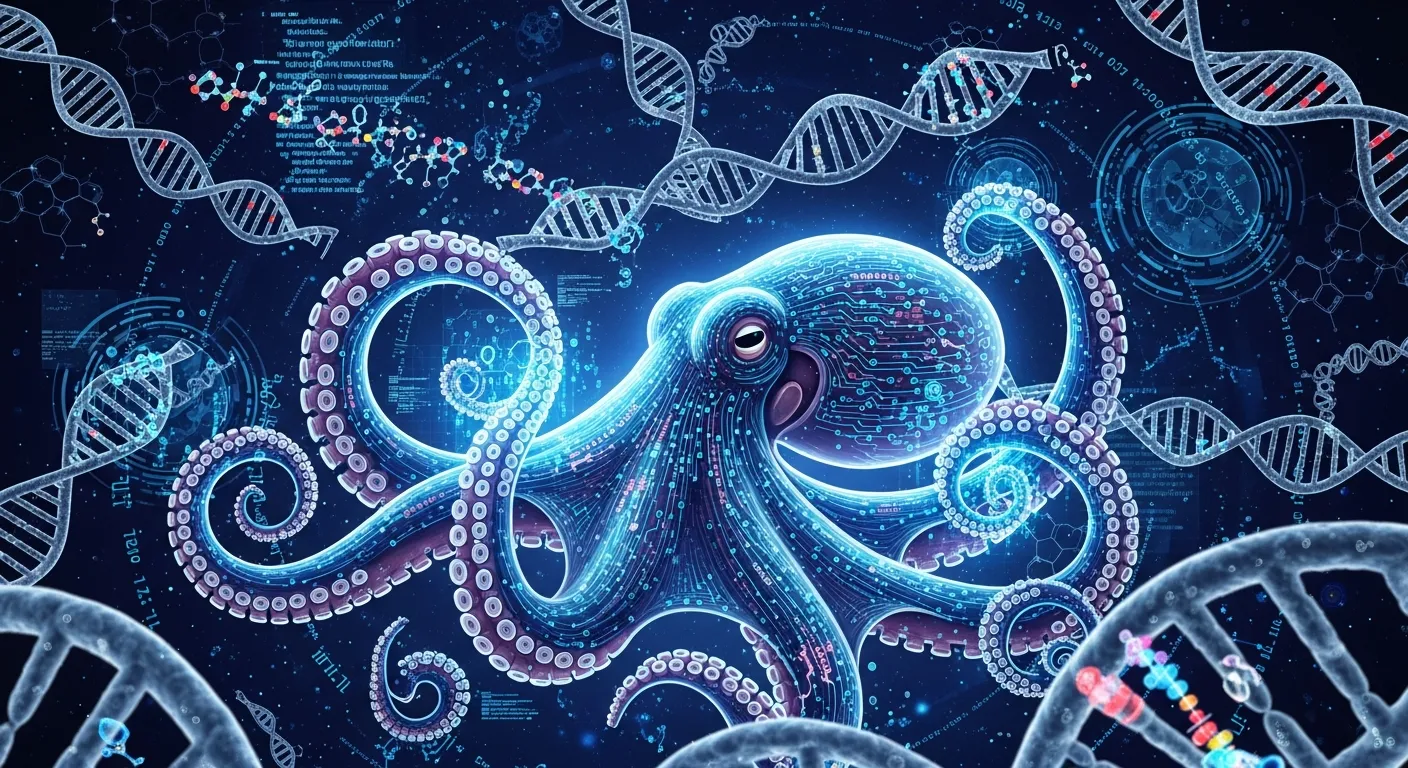
What octopuses do is called RNA editing, and they do it on a scale that makes every other animal look like they're playing with training wheels. While humans edit less than 1% of our RNA, octopuses edit up to 60% of theirs. That's not tweaking the system. that's completely rewriting it.
Think of it like this: if your DNA is the original recipe book, most animals might make tiny corrections here and there. But octopuses are completely rewriting entire chapters, switching ingredients, and creating brand new dishes on the fly.
Why This Is Absolutely Mind-Blowing
This RNA editing happens mostly in their nervous system, which explains a lot about why octopuses are so incredibly smart. They're literally modifying their brain's instruction manual in real-time, adapting their neural networks as they go.
It's like having a computer that can rewrite its own operating system while it's running. Except this computer can solve puzzles, use tools, recognize human faces, and apparently hold grudges against aquarium staff who annoy them.
Scientists think this might be one of the secrets behind octopus intelligence. While other animals are limited by their fixed genetic programming, octopuses can essentially debug and upgrade their own neural software continuously.
The Evolutionary Plot Twist
Here's where it gets really interesting: this massive RNA editing ability evolved specifically in octopuses and their cousins (cuttlefish and some squid). It's not something they inherited from ancient ancestors. they developed it independently.
This suggests that when octopuses diverged from other mollusks about 500 million years ago, they chose a completely different evolutionary strategy. Instead of gradually evolving better hardware like most animals do, they evolved the ability to constantly upgrade their software.
It's like nature gave octopuses the ability to be their own genetic engineers, and they've been running with it ever since.
What This Means for Science
This discovery is revolutionizing how we think about intelligence and evolution. It suggests there might be multiple pathways to developing complex cognition, and octopuses found one that's completely different from ours.
Researchers are now looking at whether this RNA editing ability could inspire new approaches to artificial intelligence and even medical treatments. Imagine if we could edit our RNA to fix genetic diseases or enhance specific abilities.
The octopus brain is already being studied as a model for distributed intelligence. unlike our centralized brain, octopuses have neurons spread throughout their arms, creating a network that's part individual and part collective intelligence. Add in the RNA editing, and you've got a biological system that's unlike anything else on Earth.
The Bigger Picture
Every time we study octopuses more closely, they surprise us. They're problem solvers, escape artists, and apparently genetic programmers too. This RNA editing discovery adds another layer to their already impressive intelligence repertoire.
It also makes you wonder: what other incredible biological innovations are out there waiting to be discovered? If octopuses can hack their own genetics, what other mind-bending abilities has evolution come up with that we haven't found yet?
One thing's for sure: octopuses just got even more fascinating. And in a world full of amazing science, that's saying something.