
If you thought seaweed’s main job was wrapping sushi and getting tangled around your ankles, science has a correction for you. Researchers at the Max Planck Institute for Biology Tübingen have just shown that some brown algae are carrying around entire giant viruses inside their DNA, like biological sleeper agents, and those viruses can wake up generations later.
Not fragments. Not broken leftovers. Not dusty genomic fossils. Whole giant viruses, sitting quietly inside the genome of a multicellular seaweed called Ectocarpus, waiting for the right moment to switch back on.
That sentence alone feels rude. Most of us have accepted that viruses invade cells, make a mess, and leave. These ones apparently move in, unpack, get written into the family record, and then pass themselves down to the kids.
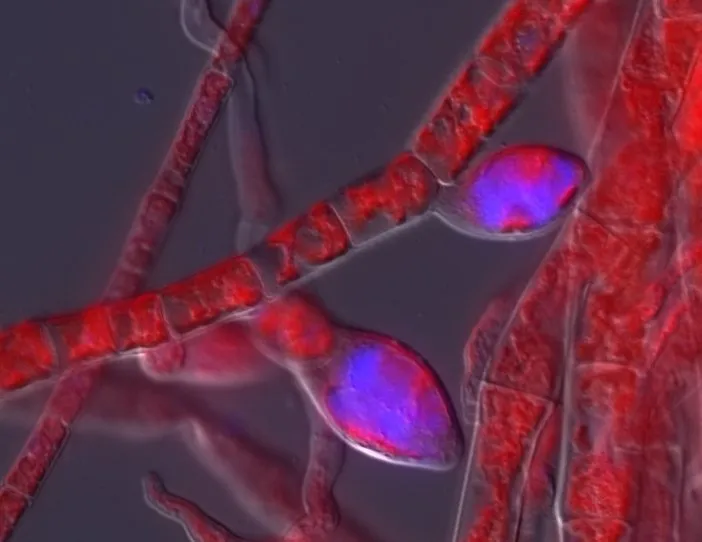
The new study, published in Nature Microbiology, found that these hidden viruses stay dormant across generations and reactivate only under very specific conditions. They wake up in the alga’s reproductive cells, and temperature helps control the timing. When that happens, the virus hijacks those cells and turns them into little virus factories, blocking normal reproduction in the process.
So yes, this is basically a microscopic inheritance drama. Grandma seaweed passes down the house, the silverware, and a latent giant virus that may or may not erupt when the water gets cold enough.
What makes this extra wild is that giant viruses were already weird before this. They are enormous by virus standards, sometimes bigger and genetically more complex than some bacteria. Scientists usually talk about them as free-living viral particles drifting around and infecting hosts from the outside. This study says that picture is incomplete. In brown algae, at least, some giant viruses can live a double life.
One life is vertical, meaning they get inherited like a gene from parent to offspring. The other is horizontal, meaning they still produce infectious particles and spread like normal viruses when they reactivate. The researchers called the integrated viral element a kind of super-gene, which is both accurate and deeply unsettling.
And here is the part I cannot stop thinking about: the virus does not just wake up randomly. It seems to respond to developmental stage and environmental cues with absurd precision. It is less like a burglar and more like a stage actor who knows exactly when their cue arrives, walks on, steals the show, and ruins the wedding.
The team backed this up with a pretty satisfying stack of evidence. They used long-read genome sequencing to map where the viral DNA sits inside the host chromosomes. They tracked when viral genes turned on. They saw virus-like particles forming in infected reproductive cells. Then, in the scientific version of pulling a fuse, they used CRISPR to delete one of the viral inserts. The symptoms vanished. That is a very strong hint that the hidden virus was not just lurking there for decoration.
There is also a bigger reason this matters. Brown algae are not obscure pond fluff. They are major foundation species in coastal ecosystems, more like underwater forests than green slime. If hidden viruses can shape how these organisms reproduce, evolve, and survive temperature swings, they could matter for whole marine ecosystems too.
But honestly, even before the ecological implications kick in, this story already wins on pure cosmic audacity. Nature keeps finding new ways to violate our mental filing system. Gene, virus, inheritance, infection. Nice neat categories, shame if something came along and sat in all four at once.
The most fun version of this discovery is also the most humbling one. A giant virus can tuck itself into seaweed DNA, stay quiet through generations, wait for the right temperature, then wake up exactly in the cells that matter most. Meanwhile humans forget why they opened the fridge.
Sources: Max Planck Society (May 18, 2026); Nature Microbiology; Phys.org