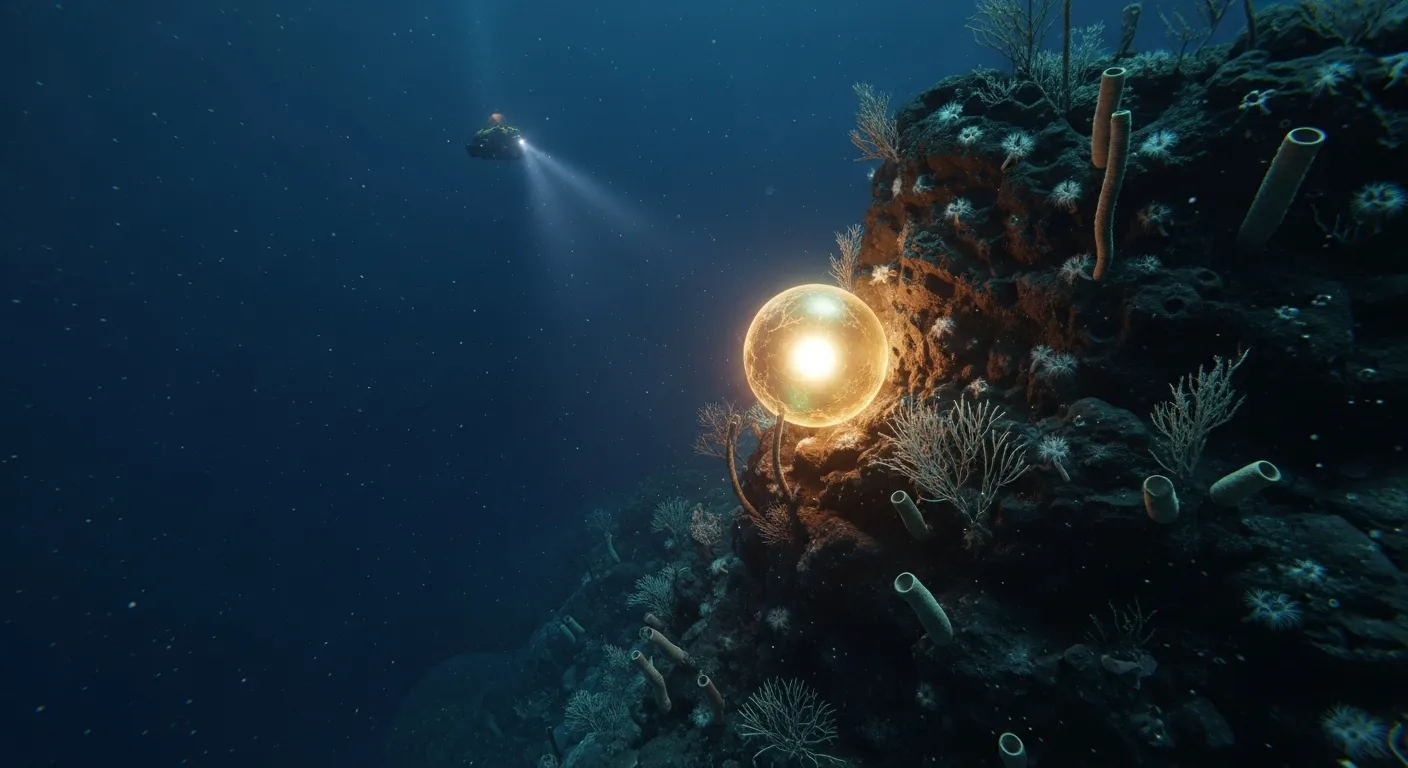

In 2023, a NOAA expedition dropped cameras nearly two miles down into the Gulf of Alaska and found something that looked like it had rolled straight out of a sci-fi prop closet. It was golden. It was squishy-looking. It had a weird little hole in it. It was glued to a rock like some kind of cursed caramel truffle from the abyss.
Naturally, the internet had a normal reaction and absolutely did not start guessing alien egg, mysterious sponge, abandoned sea pod, or the ocean's last surviving chicken nugget.
Now, after two and a half years of real detective work, scientists finally know what the so-called golden orb was. Not an alien. Not an egg sack. Not a deep-sea prank. It was the leftover base of a giant sea anemone called Relicanthus daphneae. Which, honestly, still sounds fake enough to be excellent.
The best part of this story is that even the scientists on the livestream were basically doing live group chat speculation from the ocean floor. When the remotely operated vehicle first spotted the thing, you can hear the confusion. Is it an egg case? A sponge? Did something crawl out of it? Is there another sentence nobody wants to finish?
That is the magic of deep-sea exploration. Space gets all the posters, but the bottom of our own ocean is still serving up fresh nightmare macarons on a regular basis.
To crack the case, researchers from NOAA and the Smithsonian did not just eyeball it and move on. They went full forensic mode. They studied its structure. They looked at the strange stinging cells packed into the tissue. They tried DNA barcoding, which was messy at first because deep-sea samples are basically the biological equivalent of picking lint out of a cosmic couch. Then they pushed deeper with genome sequencing and matched it to Relicanthus daphneae, a giant deep-sea anemone.
So the orb was not the whole creature. It was more like the footprint, anchor, or old basement of one. The golden blob appears to be made from dead cells at the base of the anemone, the part that attached it to the rock. The top part was gone by the time scientists found it. Maybe the animal moved. Maybe it died. Maybe the ocean decided context was overrated.
Here is a tiny blob classifier, because every great mystery deserves a totally unnecessary dashboard:
How alien does the blob feel?78 percent alien. You are allowed to whisper “absolutely not” at your screen.
There is also something deeply satisfying about the answer being both less dramatic and more interesting than the wild guesses. A leftover anemone base is not as flashy as “ancient alien pearl,” but it tells a cooler story. The deep ocean is so underexplored that even a lump stuck to a rock can trigger a years-long scientific mystery. That rules.
Also, giant deep-sea anemone is an absurdly strong phrase. It sounds like a mini boss in a video game. Yet here it is, hanging out in the real world, quietly leaving behind gold-colored biological breadcrumbs for us to freak out over.
So yes, the mystery is solved. The golden orb has been identified. But I think the bigger takeaway is that the ocean remains undefeated at producing creatures and creature-adjacent objects that make humans instantly lose their composure.
We keep saying we want to be surprised by science. Then the seafloor hands us a glowing blob with a hole in it and suddenly everyone becomes a poet, a detective, and a little bit afraid. That feels healthy.
If the ocean would like to reveal its next deeply unsettling decorative object now, I regret to inform you I will be seated.