
The Secret Ocean Worlds Hiding in Plain Sight
Forget everything you thought you knew about where life might exist in our solar system. While we've been obsessing over Mars and its ancient riverbeds, some of the most promising places for alien life have been floating around Jupiter and Saturn this whole time.
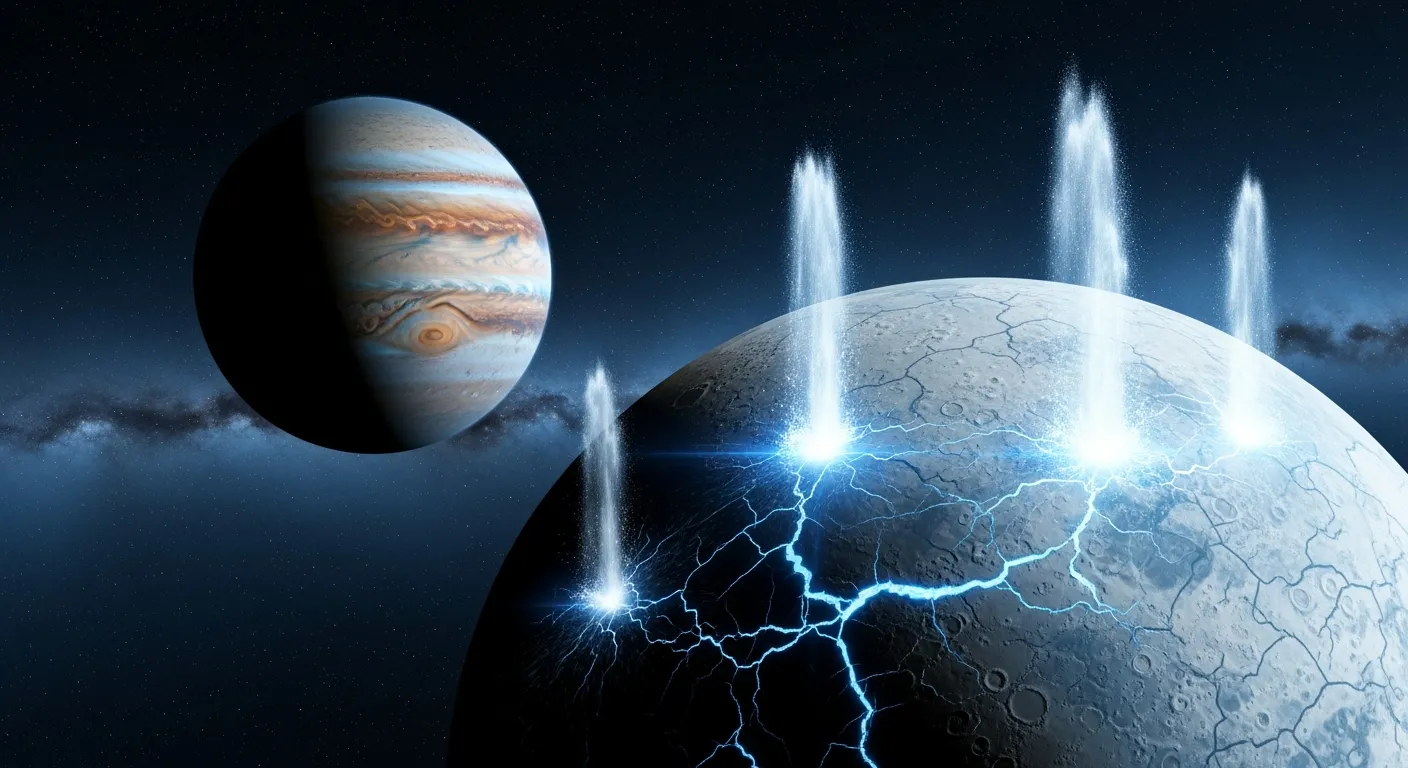
I'm talking about moons with vast, hidden oceans beneath their icy shells. Not puddles or underground streams, but actual oceans that dwarf anything on Earth. Europa, one of Jupiter's moons, has an ocean that contains more than twice the water of all Earth's oceans combined. Let that sink in for a moment.
The Invisible Ocean Club
Europa isn't alone in this exclusive club. Enceladus, Saturn's tiny moon, shoots geysers of water vapor hundreds of miles into space through cracks in its south pole. These aren't just any geysers either. They contain organic compounds, the building blocks of life as we know it.
Then there's Ganymede, Jupiter's largest moon and the biggest moon in our solar system. Scientists recently confirmed it has a subsurface ocean that might contain more water than all of Earth's surface water. Even Titan, Saturn's orange, smoggy moon, likely has a subsurface ocean beneath its thick, hydrocarbon-rich crust.
The wild part? These oceans have been there for billions of years. While Earth's surface was getting pummeled by asteroids and going through ice ages, these hidden seas have remained liquid and stable.
How Do We Know This?
The evidence comes from some pretty clever detective work. When spacecraft like Cassini and Galileo flew by these moons, they measured how the moons wobbled in their orbits. A solid ice ball wobbles differently than a moon with liquid sloshing around inside.
Scientists also studied how these moons interact with their parent planet's magnetic fields. Liquid water conducts electricity differently than ice, creating telltale signatures that sensitive instruments can detect from millions of miles away.
Mind-Blowing Fact: If you could drill through Europa's ice shell (which is about 15-25 kilometers thick), you'd find an ocean that's roughly 60-150 kilometers deep. Earth's oceans average about 4 kilometers deep.
The Goldilocks Zone Misconception
For decades, astronomers have focused on the "habitable zone" around stars, where liquid water can exist on a planet's surface. But these ocean moons are teaching us that habitability might have nothing to do with being the right distance from a star.
Instead, these moons stay warm through tidal heating. As they orbit their massive parent planets, gravitational forces constantly squeeze and stretch them, creating friction that generates heat. It's like a cosmic stress ball that never stops being squeezed.
This means ocean worlds could exist almost anywhere in a solar system, as long as they have a large planet to orbit. Suddenly, the number of potentially habitable worlds in our galaxy just multiplied by orders of magnitude.
What's Living Down There?
We obviously don't know yet, but the conditions are surprisingly promising. These oceans are in contact with rocky seafloors, which could provide the chemical energy that life needs. On Earth, some of the most extreme and oldest forms of life thrive in similar environments around deep-sea hydrothermal vents.
The water on these moons is also slightly salty and contains dissolved minerals. Enceladus's geysers have revealed hydrogen gas, which on Earth serves as food for certain microbes. Europa's ocean might even have more oxygen than Earth's oceans did when life first emerged here.
The Search Continues
NASA is planning to launch Europa Clipper in the coming years to get an up-close look at Jupiter's most promising moon. The mission will map Europa's ice shell and analyze those tantalizing water plumes to see what's really going on underneath.
Meanwhile, scientists are already planning follow-up missions that could actually land on these moons and drill through the ice. Imagine getting water samples from an alien ocean. We might not have to travel to another star system to find life after all.
The universe just got a lot more interesting, and a lot more crowded with potential neighbors.