
What If Your Mouse Pointer Actually Understood You? DeepMind Just Answered
The mouse pointer has not changed in any meaningful way since 1963. That little arrow on your screen is older than the internet, older than cell phones, older than video games. For sixty-three years, it has done exactly one thing: point. It does not understand what it is pointing at. It does not know why you are pointing there. It is a passive piece of interface decoration, a digital finger that never learns.
Google DeepMind is done with that.
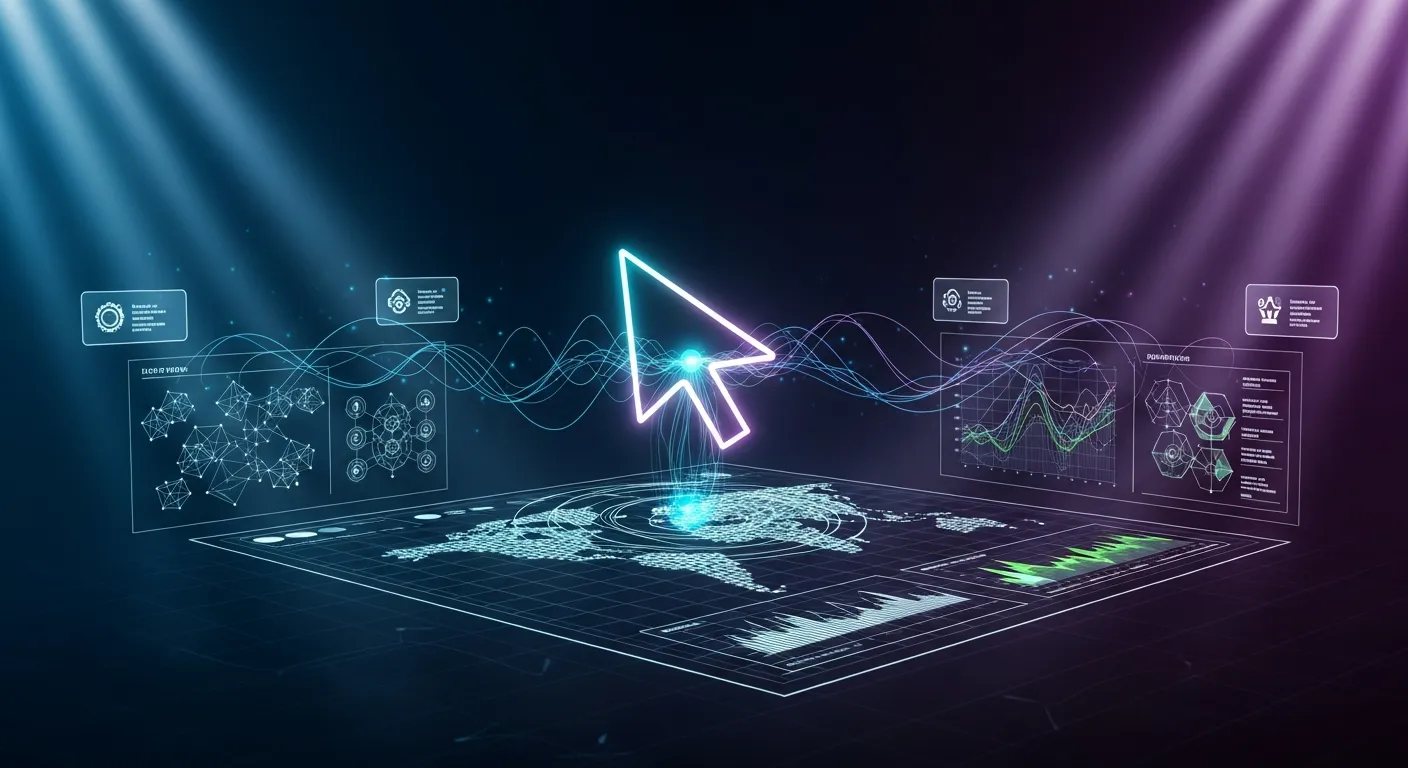
Earlier this week, the company unveiled a radical rethinking of the pointer itself. Behind the scenes, it is not just an arrow anymore. It is a portal to Gemini, Google's AI model, and it can actually understand what is on your screen in real time. Point at a photo of a building, say "Show me directions," and it gets it. Highlight a table of statistics and ask for a pie chart version. Hover over a recipe and double the ingredients. No copy-pasting. No dragging things into an AI chat window. No switching apps. Just point and speak.
This sounds small until you think about how you actually use a computer right now. If you want AI help with something, you have to interrupt your entire workflow. You open ChatGPT or Claude in another tab, describe what you are looking at, paste a screenshot, or copy the text over, and then hope the AI understood your context correctly. It is clunky. It breaks your focus. DeepMind's team calls these "AI detours," and they want to eliminate them entirely.
The research, led by Adrien Baranes and Rob Marchant, centers on four principles. Maintain the flow, so AI works across every app without forcing you into separate windows. Show and tell, so the pointer captures both visual and semantic context automatically. Embrace the power of "this" and "that," so you can say "Fix this" or "Move that here" and the AI knows exactly what you mean. And turn pixels into actionable entities, so a photo of a scribbled note becomes an interactive to-do list and a paused travel video frame becomes a booking link for that cool-looking restaurant.
The technical backbone is genuinely impressive. Every time the pointer moves, Gemini is processing the visual and semantic context around it in real time. It identifies objects, text, places, dates, and entities on the fly. A byte-encoding compression technique cuts memory requirements by a factor of eight, and the whole thing runs across more than sixteen thousand NVIDIA GH200 Superchips when it needs to scale.
But the most interesting part is not the hardware. It is the philosophy. For decades, computers have tracked where we are pointing. Now they can understand what we are pointing at. That distinction matters. It flips the interaction model from user-adapts-to-computer to computer-adapts-to-user. We have been doing the hard work of conveying context and intent. DeepMind wants the computer to do that work instead.
Google is already integrating this into Chrome and their new Googlebook laptop. The "Magic Pointer" feature is rolling out now, letting users point at anything on a webpage and ask Gemini about it directly. Select products on a shopping site and ask for a comparison. Point to a blank space in your room and visualize how a new couch might look. It is the kind of interaction that feels obvious in hindsight but required years of research to make possible.
There is a broader implication here that goes beyond Google. Every major tech company is racing to own the AI interface layer. Apple has its Apple Intelligence baked into the OS. Microsoft has Copilot embedded throughout Windows. OpenAI is building its own devices. But the pointer is universal. It works on every operating system, every website, every app. If Google can make the pointer itself intelligent, they bypass the need for users to choose a specific AI assistant. The pointer becomes the assistant.
Of course, there are questions. Privacy is the obvious one. If your pointer is constantly analyzing your screen, what data leaves your device and what stays local? Google says the processing is designed with privacy in mind, but the specifics matter. There is also the risk of over-reliance. If we get used to just pointing and asking, do we stop learning how to do things ourselves? Does an AI-enabled pointer make us more capable, or just more dependent?
These are the same questions we asked about calculators, spell-check, and GPS. The answer has historically been: both. We become dependent on the tool, but we also free up mental energy for harder problems. The key is whether the tool actually makes us more effective, not just more comfortable.
For now, this is still experimental research. The demos look smooth in promotional videos, but real-world use always reveals friction. How does it handle complex layouts? What happens when multiple overlapping elements confuse the pointer? Does it work reliably on older hardware?
Still, the direction is right. The mouse pointer has been begging for an upgrade since before most of us were born. DeepMind just gave it a brain. And if they pull this off, the way we interact with computers is about to change in a way that makes touchscreens feel like a temporary detour.
Sometimes the most radical innovations do not look radical at all. They look like a cursor. Moving across your screen. Finally paying attention.
Source: Google DeepMind Research Blog, May 12, 2026