
Here is a sentence that should not make sense: scientists injected a mouse with microscopic particles, and within sixty minutes, half the toxic brain plaques associated with Alzheimer's disease had vanished. No chemicals. No antibodies. The particles themselves were the therapy, and the brain did the actual cleanup.
If that sounds like science fiction, the mice would disagree. In a study published yesterday in *Signal Transduction and Targeted Therapy*, an international team led by the Institute for Bioengineering of Catalonia (IBEC) and West China Hospital Sichuan University reported something genuinely striking: they reversed Alzheimer's-like symptoms in mice using specially engineered nanoparticles that do not deliver medicine. They *are* the medicine.
How We Got Here
For decades, Alzheimer's research chased plaques. The sticky protein clumps called amyloid-beta build up in the brain, neurons die, memory fades, and the disease wins. Most therapies tried to attack the plaques directly, like sending a wrecking crew into a cluttered warehouse. The problem is that the warehouse itself was already falling apart.
The new insight is architectural. The brain is wrapped in the blood-brain barrier, a dense mesh of cells and capillaries that controls what goes in and out. In Alzheimer's, this barrier breaks down. Waste removal stalls. Amyloid-beta accumulates because the brain's plumbing is clogged, not because the brain forgot how to clean.
The Nanoparticles That Reset the Plumbing
The researchers built what they call "supramolecular drugs" — bioactive nanoparticles designed to mimic natural molecules that interact with a protein called LRP1. Think of LRP1 as the brain's garbage truck. It normally binds amyloid-beta, hauls it across the blood-brain barrier, and dumps it into the bloodstream for disposal. In Alzheimer's, this truck breaks. If LRP1 grabs amyloid too tightly, the machinery jams. Too loosely, and nothing gets picked up. Either way, the trash piles up.
The nanoparticles step in like a mechanic. By precisely mimicking the natural signals LRP1 expects, they appear to "reset" the transport system. The blood-brain barrier starts working again. The brain's own cleanup crew wakes up. And the plaques begin to dissolve.
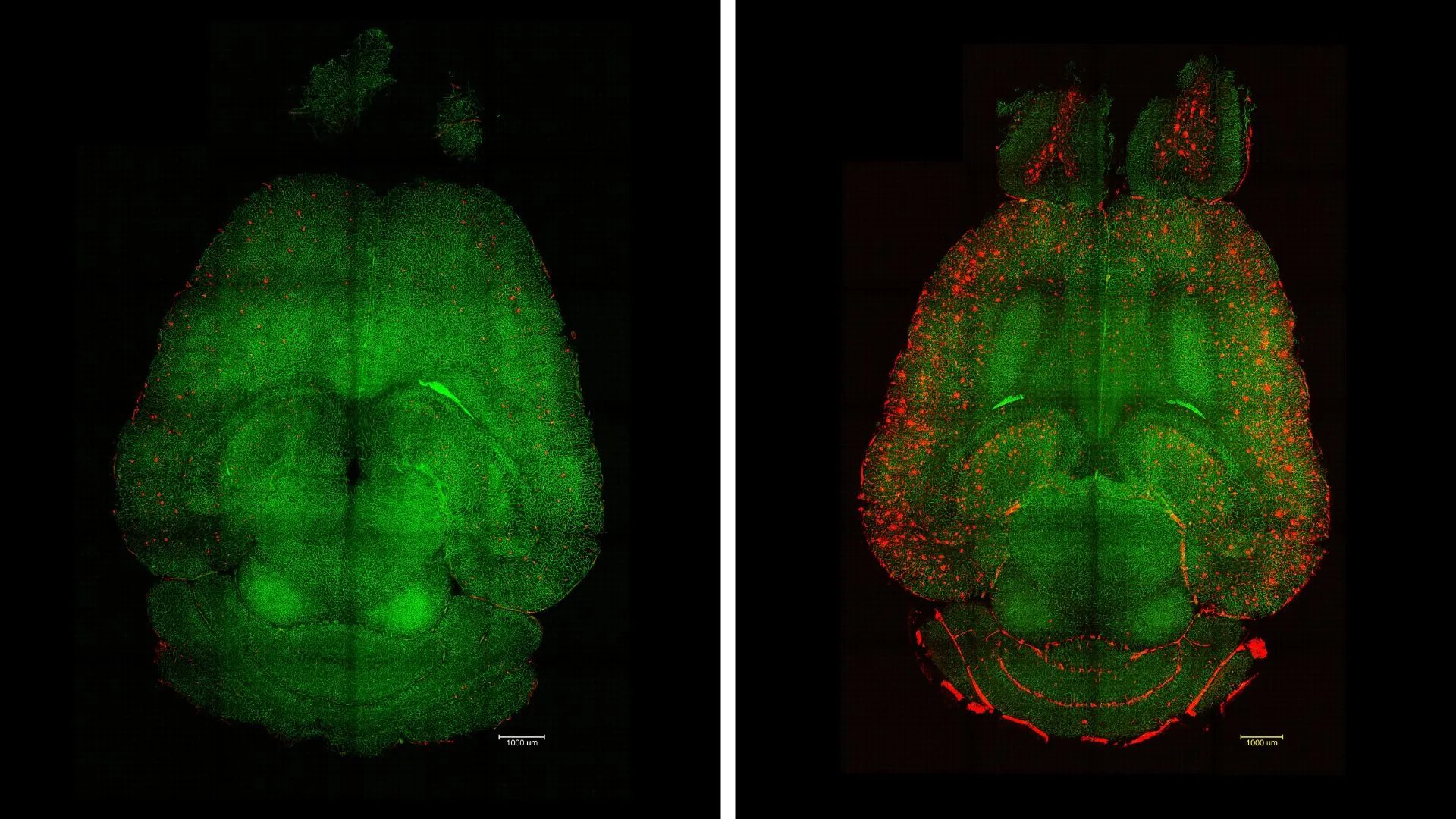
The speed is what stuns. "Only 1h after the injection we observed a reduction of 50-60% in Aβ amount inside the brain," said Junyang Chen, a co-first author on the study and researcher at West China Hospital. That is not gradual improvement. That is a brain rebooting its waste disposal in real time.
The Long Game
Short-term clearance is impressive, but Alzheimer's is a disease of years. So the team tracked treated mice for months. In one experiment, they treated a 12-month-old mouse — roughly the equivalent of a 60-year-old human — and checked back six months later, by which point the animal was more like a 90-year-old human. Despite its age, it behaved like a healthy, younger mouse with no signs of cognitive decline.
"The long-term effect comes from restoring the brain's vasculature," explained Giuseppe Battaglia, the ICREA professor who led the study. "We think it works like a cascade: when toxic species accumulate, disease progresses. But once the vasculature is able to function again, it starts clearing Aβ and other harmful molecules, allowing the whole system to recover its balance."
In other words, the nanoparticles fixed the infrastructure, and the brain healed itself.
Why This Approach Is Different
Most nanomedicine uses particles as delivery trucks. You load a drug onto a nanoparticle, steer it to a target, and release the payload. This study flips the model. The particles are not carrying anything. Their shape, size, and surface chemistry are the entire therapy. By influencing how receptors move and function on cell membranes, they restore biological pathways rather than forcing a chemical solution.
That matters because it sidesteps a brutal reality: many Alzheimer's drugs that work in mice crash in human trials. If the problem is partly that we have been attacking symptoms instead of restoring systems, then infrastructure repair might be a fundamentally better strategy.
The Obvious Caveat
These are mice. Genetically engineered mice, at that. The history of Alzheimer's research is littered with therapies that looked miraculous in rodents and meaningless in humans. This study is still early-stage animal research, and clinical translation is years away, if it happens at all.
But the mechanism is what makes it worth watching. The idea that Alzheimer's might be driven as much by vascular failure as by plaque buildup is gaining serious traction. If the brain's billion capillaries really are the front line, then fixing them might matter more than bombing the proteins they are supposed to clear.
What Comes Next
The research team is already thinking about how this approach could complement existing therapies, including the anti-amyloid antibody drugs that have recently shown real promise in humans. One of the biggest challenges those drugs face is getting enough medicine across the blood-brain barrier safely. If nanoparticles can restore barrier health while other therapies attack plaques, the combination could be more powerful than either approach alone.
For now, the most honest takeaway is this: a group of scientists built microscopic particles that convinced a damaged brain to clean its own house. Within an hour, the garbage was already halfway gone. If that ever works in humans, it will not be because we found a better way to fight Alzheimer's. It will be because we finally learned how to get out of the brain's way.
Sources: Institute for Bioengineering of Catalonia (IBEC); *Signal Transduction and Targeted Therapy* (May 2026); West China Hospital Sichuan University; University College London