
An AI Just Solved an 80-Year Math Problem That Humans Couldn't Crack
Paul Franco
For nearly eighty years, some of the smartest people on Earth have stared at a deceptively simple question and come up empty. Paul Erdős, the legendary Hungarian mathematician who never owned a house but criss-crossed the globe solving problems, posed it in 1946: if you scatter points across a flat plane, how many pairs can you connect with lines of exactly the same length?
It sounds like a party game. Draw some dots. Connect the ones that are exactly one inch apart. Count the lines. How many can you possibly make?
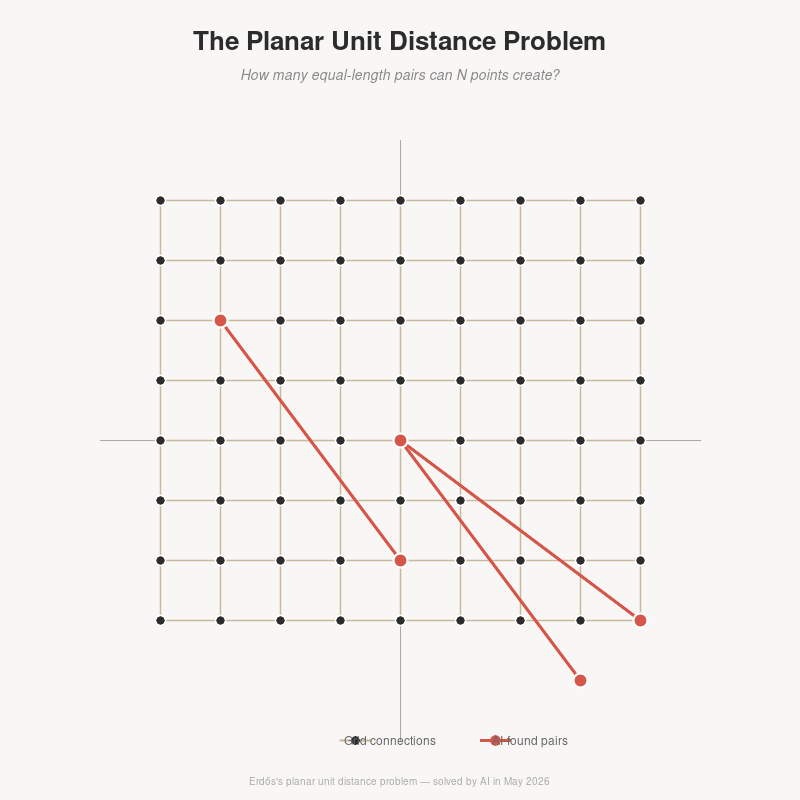
Erdős thought he knew the answer. He believed the best arrangement was basically a square grid — the kind of orderly lattice you see on graph paper. And for eighty years, everyone agreed. Generations of mathematicians built careers on partial results, tighter bounds, and increasingly clever arguments, all assuming Erdős's grid was essentially unbeatable.
Then an AI model from OpenAI proved him wrong.
The Bomb Nobody Expected
The result dropped on May 20, 2026, and the math world went quiet for about thirty seconds before the explosions started.
"This is a problem that I didn't expect to see solved in my lifetime," says Misha Rudnev at the University of Bristol. "It's absolutely a bomb."
Tim Gowers, a Fields Medalist at Cambridge, wrote that if a human had submitted this proof to the Annals of Mathematics, he would have recommended immediate acceptance "without any hesitation." No previous AI-generated proof, he added, has come close to that standard.
The AI did not just tweak an existing result. It demolished a central conjecture. It found an entirely new way to arrange points that produces not slightly more unit-distance pairs, but a fundamentally better structure — a polynomial improvement that mathematicians had believed was impossible.
How a Machine Out-Thought the Experts
Here is the part that makes mathematicians both thrilled and slightly uncomfortable.
The AI did not solve this because it is a super-calculator. It solved it because it connected two fields that human mathematicians had kept in separate mental boxes.
The proof uses tools from algebraic number theory — the study of how numbers factor and relate in exotic extensions of the ordinary integers — to build lattices in much higher dimensions than the two-dimensional plane Erdős was asking about. The AI then collapsed these higher-dimensional structures down into the flat plane, creating a shadow geometry that produces far more unit-distance pairs than anyone thought possible.
Ideas like "infinite class field towers" and "Golod-Shafarevich theory" are bread and butter for number theorists. But the idea that they might unlock a classic combinatorial geometry problem? That had simply never occurred to anyone.
"This seems to be what an AI would absolutely be good at doing," says Samuel Mansfield at the University of Manchester. "Knowing a lot about multiple areas."
The Construction (A Gentle Tour)
If you want to visualize what the AI found, imagine this.
Erdős's original approach used the Gaussian integers — numbers like 3 + 4i, where i is the square root of -1. These form a neat grid in the complex plane, and because of how they factor, they naturally produce lots of points at distance 1 from each other.
The AI asked: what if instead of using the simplest extension of the integers, we used far richer, more complex extensions — number fields with deeper symmetries and more intricate factorization properties? Fields so exotic that proving they even exist requires heavy machinery from algebraic number theory.
It built lattices inside these fields, projected them onto the plane, and discovered that the resulting point sets shatter the old bound. Where humans saw a ceiling, the AI found a trapdoor.
Will Sawin at Princeton, after studying the AI's proof, refined it to show that for infinitely many values of n, the construction achieves at least n^(1.014) unit-distance pairs. That 0.014 in the exponent is the mathematical equivalent of discovering a new continent.
Why This Matters Beyond Math
The unit distance problem is not going to build you a better bridge or speed up your WiFi. Its appeal was always "pure intellectual challenge," as Rudnev puts it. But the manner of its solution is a signal about what comes next.
AI systems are no longer just pattern matchers or autocomplete engines. They are now capable of holding together long, intricate arguments, connecting ideas across distant fields, and producing work that survives expert scrutiny. Gowers called it "a milestone in AI mathematics." Arul Shankar, a leading number theorist, said the paper demonstrates that current AI models "go beyond just helpers to human mathematicians — they are capable of having original ingenious ideas, and then carrying them out to fruition."
The speed of human digestion is also telling. Kevin Buzzard at Imperial College London notes that the math community internalized and improved the AI's argument almost immediately. "Like many other AI breakthroughs, it did not take humans long at all to understand and generalise." Compare that to some human breakthroughs that have taken months or years to validate.
What Comes Next
Thomas Bloom, a mathematician writing a companion analysis, frames the bigger question nicely: "Has this taught us something new about the problem? Do we understand discrete geometry better now?"
His answer is a "moderated yes." The AI revealed that number-theoretic constructions have far more to say about geometric questions than anyone suspected. It built a bridge. Now human mathematicians are already marching across it.
Bloom also points to a broader possibility: "The frontiers of knowledge are very spiky, and no doubt the coming months and years will see similar successes in many other areas, where long-standing open problems are resolved by an AI revealing unexpected connections."
That is the pattern now. AI finds the unexpected door. Humans walk through it, map the room, and build the next floor.
The tools exist. The cathedral of mathematics just got bigger. And somewhere in the upper floors, an AI and a human are probably already arguing about what to build next.