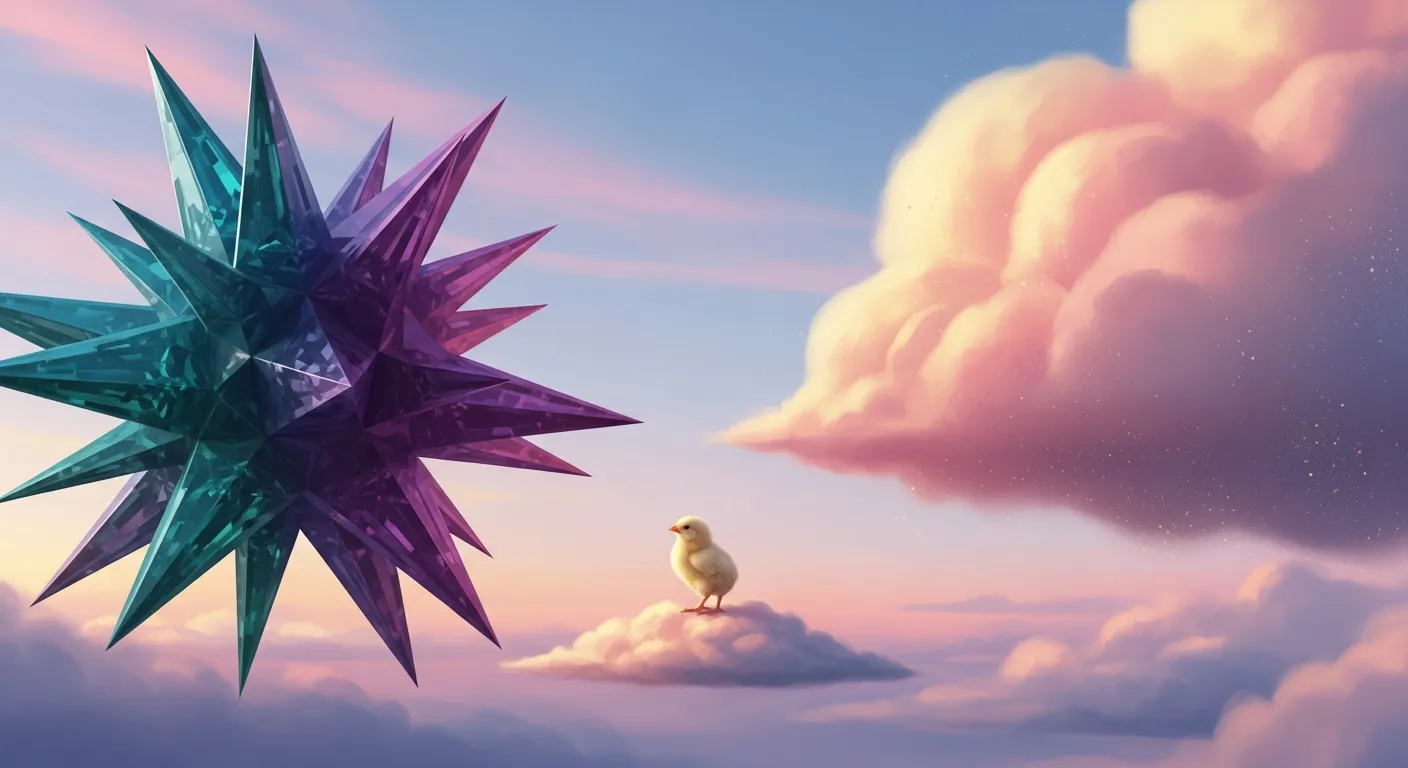

Here is a quick experiment. Look at these two shapes. One is soft and blobby. The other is sharp and spiky.
Now tell me: which one is bouba, and which one is kiki?
If you said bouba is the round one and kiki is the pointy one, congratulations. You just did what roughly 95% of humans do, across every culture and language ever tested. Even four-month-old babies get it right.
Here is the weird part. Day-old chickens do too.
Researchers at the University of Padova in Italy recently published a study in Science that is making linguists reconsider a theory they have held for decades. They played recordings of bouba and kiki to chicks that had been alive for less than 72 hours. The chicks had never heard human speech. They had never seen a shape in their lives. And yet, when they heard bouba, they walked toward the round blob. When they heard kiki, they went for the spiky star.
Scientists call this the bouba-kiki effect. It is one of the most reliable findings in all of psychology. Show anyone, anywhere, a round shape and a jagged shape, and they will almost always map soft sounds to soft shapes and sharp sounds to sharp ones. The effect is so universal that researchers have long suspected it must be wired into us somehow. Maybe it is a foundational stepping stone that helped human language evolve. If our brains are already predisposed to link certain sounds to certain meanings, that gives early humans a shared starting point for inventing words.
There is just one problem. Until now, nobody could find the bouba-kiki effect in animals.
Chimpanzees do not show it. Gorillas do not show it. Great apes, our closest relatives, just sit there looking confused when you ask them to match sounds to shapes. That made the theory tricky. If bouba-kiki is supposed to be an evolutionary foundation for language, why would only humans have it?
The Italian team had a different idea. Maybe great apes were the wrong animals to test. Maybe the effect is not about language at all. Maybe it is about something deeper, something baked into the sensory systems of virtually all vertebrates. Something that goes back hundreds of millions of years, to a common ancestor of birds and mammals.
So they tried chickens.
Chicks are perfect for this kind of experiment because they hatch fully formed and can be tested almost immediately. A three-day-old chick has had almost no life experience. If it shows the effect, the effect is almost certainly innate, not learned.
The setup was simple. The researchers taught chicks to go behind a panel for food. Then they presented two new panels, one with a blob and one with a spike, and played either bouba or kiki on repeat. The chicks chose the matching shape significantly more often than chance. In a second experiment with even younger, one-day-old chicks, the researchers showed moving shapes on screens. When kiki played, the chicks approached the spiky object. When bouba played, they went for the round one.
Let that sink in. A creature that just emerged from an egg, with no exposure to human culture, language, or even much visual experience, already knows that kiki sounds pointy.
What this means is huge. The bouba-kiki effect is probably not a quirk of human brains. It is a property of brains in general, at least across the vertebrate lineage. As linguist Marcus Perlman put it, the finding suggests that vertebrate sensory systems are primed to expect certain regularities in the world.
In other words, the link between sound and shape is not something we invented. It is something we inherited. Our ancestors did not have to build language from scratch. They had a head start.
There is still a massive gap between a chick gravitating toward a blob and a human writing poetry. What separates us from chickens is not this single association. It is the ability to stack thousands of these associations into a system of shared meaning. Humans can invent new symbols on the fly. We play verbal charades. We create metaphors, jokes, and lies. No other animal does that.
But the raw material, the wiring that lets us hear bouba and immediately feel roundness, appears to be ancient. Older than mammals. Older than the split between birds and us.
So the next time you see a round pizza and instinctively think it looks friendly, or you look at a cactus and somehow feel that it sounds spiky, remember: your brain is not being poetic. It is being a vertebrate.
And somewhere out there, a day-old chick is doing exactly the same thing.