
Deep in the Kinnaur district of Himachal Pradesh, where snow-fed orchards cling to mountain slopes and village roofs catch the last copper light of the day, something ancient happens every spring. It is called Raulane, and until recently, almost nobody outside the valley had ever heard of it.
Then the internet found it.
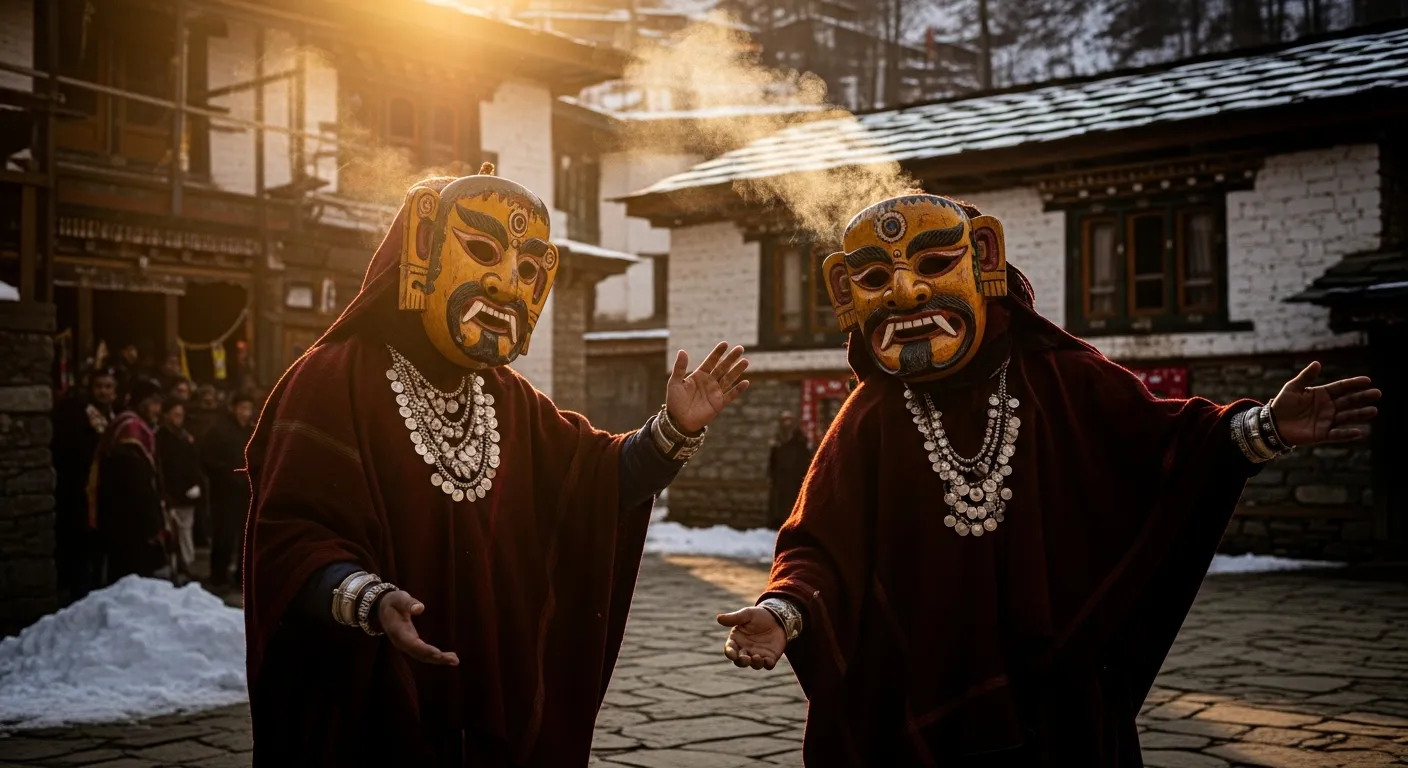
Sometime in late 2025, photographs started spreading across Instagram and X. Faces completely concealed behind elaborate wooden masks. Silver and gold jewellery glinting against heavy wool shawls. Men dressed in bridal finery, heads crowned with vivid Styrofoam flowers, bodies wrapped in layers of handwoven cloth. The images looked almost alien, like stills from a film that does not exist. Travel blogs picked them up. AI chatbots scraped them and turned them into wallpapers. Comment sections filled with the same question: what on earth is this?
The answer is even stranger than the pictures.
The Sauni: Mountain Spirits Nobody Questions
For thousands of years, the villages of Kinnaur have believed in beings called the Sauni. These are not ghosts in the Western sense. They are mountain spirits, guardians, entities who descend from the alpine meadows during the harshest winter months to watch over homes, livestock, and families. When storms howl through the valleys and the roads disappear under snow, the Sauni are said to be there, invisible but present, shielding the community from unseen danger.
When spring finally pushes through, the spirits retreat to their high pastures. And that is where Raulane begins.
The festival is a farewell. A ritual thank-you. A ceremonial escort back to the realm from which the Sauni came. It happens around the days after Holi, usually in early March, though the exact timing shifts from village to village. In some places it lasts five days. In others, it is compressed into a single afternoon of song, fire, and movement. There is no fixed calendar. Mountain life resists that kind of order.
The Raula and Raulane: Two Men, One Sacred Pair
At the centre of the festival are two chosen villagers: the Raula and the Raulane. Despite looking like a bride and groom, both roles are performed by men. They are completely transformed. Their bodies vanish under layers of Kinnauri wool, ornate heirloom jewellery, veils, and elaborate headpieces. Their faces disappear behind carved wooden masks with strong, almost severe features.
This is not just costume. It is the shedding of personal identity.
By covering every visible trace of who they are, the performers enter what locals describe as a liminal, sacred space. They are no longer individuals. They are intermediaries, temporarily bridging the human world and the world of the Sauni. Once dressed, they do not speak. Their movements are slow and deliberate, almost trance-like, as they walk through the village lanes, pause before shrines, and receive offerings from people who have known this ritual since childhood.
The silence is the point. The mask is a boundary. It reminds the community that what they are witnessing is not theatre. It is conversation with the mountains.
A Puja at the Edge of the World
The procession winds through narrow lanes where villagers cheer, laugh, and exchange jokes. There is warmth here, even joy, despite the deep spiritual weight of what is happening. Some locals believe the more the Raula laughs during the walk, the more prosperous the coming year will be.
Eventually the pair reaches the Nagin Narayan Temple, an ancient shrine that sits at the heart of Kinnaur's spiritual life. Here, the Raula and Raulane perform a slow, meditative dance. Not a performance for an audience. More like a prayer made visible. Gentle, rhythmic steps that are believed to open a passage between worlds. A quiet closing of the door through which the Sauni descended months before.
When it is over, the spirits are thanked, satisfied, and sent back. Winter is officially finished. The sowing season can begin.
The Internet versus the Village
The irony of Raulane going viral is that the festival was never meant to be watched. It exists for the community, not for cameras. Travel photographer Kanwar Pal Singh, who captured some of the images that broke the story open, has been blunt about this. In interviews with Indian media, he urged visitors to respect boundaries. Locals worry that if outsiders treat the ritual as a spectacle, if crowds swell and beer cans appear near temple grounds, the festival could be closed to everyone.
That tension is real. Raulane has survived for what locals say is five thousand years, though the exact age is impossible to verify. What matters is that the tradition is continuous, passed down through oral stories, through grandmothers retelling legends, through children learning chants they do not yet understand. It is heritage maintained through practice, not preservation in a museum.
How to Witness It (If You Are Serious)
If you want to see Raulane for yourself, the logistics are not easy. The nearest airport and railway station are in Shimla. From there, National Highway 5 winds through forests and cliffs into Kinnaur, with Reckong Peo serving as the gateway to Kalpa and the surrounding villages. Roads are treacherous. Buses are limited. The festival space itself is small.
And the dates change. The only reliable way to know when it happens is to ask local elders or homestay hosts. In 2026, it was expected shortly after Holi in early March. Next year could be different.
Those who make the journey describe something rare. A moment where the modern world falls away, and you find yourself in a courtyard where humans and mountains still speak to each other. Where two masked figures move through silence, and the valley holds its breath.
The internet can show you the masks. It cannot show you that.
Sources: Outlook Traveller, Indian Express, ABP Live, Times of India, Times Now