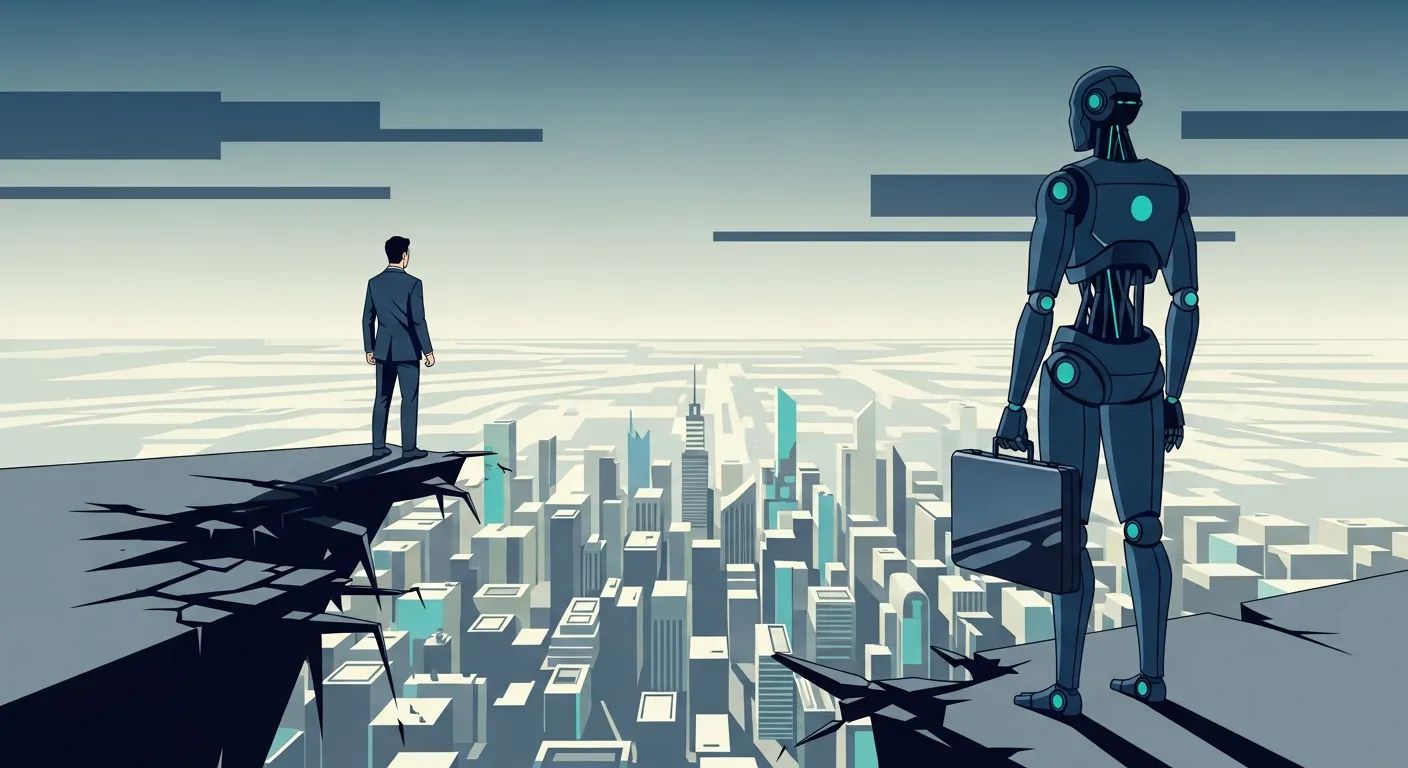

Remember when working in tech was the dream? Fancy offices with slides and nap pods. Free meals from Michelin-starred chefs. Remote work from Bali. Stock options that turned interns into millionaires. For a decade, tech was the only industry where you could wear a hoodie to a job interview and get hired because you were "too cool for a suit."
Now those same offices are half-empty. The free meals are gone. The stock options are underwater. And the hoodie-wearers? They are updating LinkedIn at 2 AM, applying to 800 jobs, and moving into trailers because the rent in San Francisco does not care that AI replaced their code.
Something wild happened. Tech went from the coolest job on Earth to the one everyone is quietly warning their kids about. And it happened faster than anyone expected.
The Golden Age That Was Never Going to Last
From roughly 2010 to 2022, tech was a cultural phenomenon, not just an industry. Google had massage therapists. Facebook had a rooftop park. Netflix openly told employees to take as much vacation as they wanted. Startups competed on who could offer the most absurd perks. One company offered a $10,000 annual stipend for "personal growth." Another gave employees a literal Tesla after their first year.
The message was clear: tech workers were special. They were not cogs. They were creative geniuses who happened to write code. The industry needed them so badly that it would do anything to keep them happy.
College enrollment in computer science exploded. Bootcamps popped up on every corner. "Learn to code" became the universal career advice, the new "go to law school." Parents pushed their kids into programming the way previous generations pushed medicine.
And then the music stopped.
The Reckoning
According to Challenger, Gray & Christmas, tech layoffs hit 33,281 workers in October 2025 alone. That is the worst October for job cuts since 2003. Not even the 2008 financial crisis was this brutal. Year-to-date, tech companies have announced 141,159 layoffs in 2025, up from 120,470 in the same period in 2024.
Amazon cut 14,000 corporate jobs. Microsoft laid off 9,000 employees over the summer. Meta, Google, Salesforce, and dozens of others have been in a seemingly endless cycle of "restructuring."
What makes this different from normal downturns is that the jobs are not coming back. Companies are not "pausing hiring." They are actively replacing the work with AI systems. Microsoft CEO Satya Nadella actually suggested laid-off workers use AI chatbots to "reduce the emotional and cognitive load that comes with job loss." Let that sink in. The company that fired you wants you to chat with its AI about how it feels.
The Cruel Irony: Creatives Were Supposed to Be Safe
Here is where it gets weird. Tech workers and creatives were supposed to be the last people AI would replace.
The logic was simple. AI could handle repetitive tasks. Data entry. Manufacturing. Driving trucks. But creativity? Coding? Problem-solving? Those were human-only zones. The robots would take the boring jobs and leave the interesting ones for us.
That is not what happened.
AI came for creatives first. Writers, designers, illustrators, video editors. Tools like Midjourney and DALL-E can generate artwork in seconds that would take a human artist days. Copywriters who used to charge $500 per blog post are competing with ChatGPT, which costs $20 per month and writes unlimited drafts. EMarketer reports that marketers now say AI is coming for creative teams before any other department.
Then AI came for coders. GitHub Copilot writes boilerplate code. ChatGPT debugs errors. Cursor and Replit have AI that can build entire apps from prompts. The irony is brutal. The people who built AI are now watching it build the next version without them.
As one recent analysis put it: "The middle of creative production is disappearing." The industry is becoming a barbell: a small number of elite human creators at the top, a massive wave of AI-generated content in the middle, and everyone else fighting for scraps.
Why Tech Will Still Exist, Just With Fewer People
Here is the uncomfortable truth. Technology is not going away. It is getting more powerful and needing fewer humans.
Look at quantum computing. The University of Houston and IonQ recently projected a 600,000-worker shortfall in the global quantum industry by 2030. That sounds like good news for jobs, except the reality is more complicated. Quantum computing does not need millions of engineers. It needs thousands of highly specialized ones. The growth is exponential in capability, not in employment.
One quantum algorithm can solve in minutes what would take classical computers centuries. That means the "workforce" for those problems shrinks from thousands of data-center engineers to a handful of quantum physicists and their machines.
The same pattern is happening across tech. Cloud computing automated server management. DevOps tools automated deployments. AI is now automating the coding itself. Each wave of technology makes the previous army of workers unnecessary.
Tech will still be in demand. But the demand will be for the best people, not the most people. Junior developers who used to learn by doing grunt work now find that grunt work is done by AI. The ladder has no bottom rungs.
The Junior Problem
This might be the scariest part.
For decades, tech had a beautiful career path. You started as a junior, learned on the job, moved to mid-level, then senior, then staff or management. The industry was so desperate for talent that it would hire smart people and train them.
Now AI has killed the entry level. Why would a company hire a junior developer who needs mentorship, makes mistakes, and takes six months to get productive, when AI can write the code instantly and a senior engineer can review it?
Bootcamp graduates who paid $15,000 for a certificate are discovering that the certificate is worthless if no one hires juniors anymore. Computer science majors, the ones who were told they had guaranteed employment, are facing unemployment rates that would have been unthinkable five years ago.
One laid-off software engineer reported applying to 800 jobs, getting rejected from all of them, and eventually moving into a trailer. The "learn to code" advice that was supposed to be a lifeline became a trap.
The Bigger Picture
What we are watching is not just a tech recession. It is a fundamental restructuring of what "work" means in an AI economy.
For a brief moment, tech created a new social contract. Smart, creative people could get paid well to do interesting work in comfortable environments. It felt like the future had arrived early.
Now that contract is being rewritten. AI has proven that creativity and coding are not uniquely human. They are patterns. And patterns can be learned by machines. The "specialness" of tech workers was an illusion created by scarcity. When the scarcity disappears, so does the specialness.
The question is not whether tech jobs will exist. They will. But the golden age of tech employment, the era of abundance and perks and easy growth, is over. What replaces it will be smaller, harder, and more competitive. The slide in the office is gone. The nap pod is empty. And the hoodie-wearers are learning that being cool was never the same as being safe.
Welcome to the next chapter. It is going to be a lot less comfortable.
Sources
- Futurism — Tech Workers Are in Deep, Deep Trouble
- Challenger, Gray & Christmas — October 2025 Job Cut Report
- eMarketer — AI is coming for your creative team first, marketers say
- Mumbrella — Eaten alive: The middle of creative production is disappearing
- University of Houston — 600,000-Worker Shortfall in Global Quantum Industry