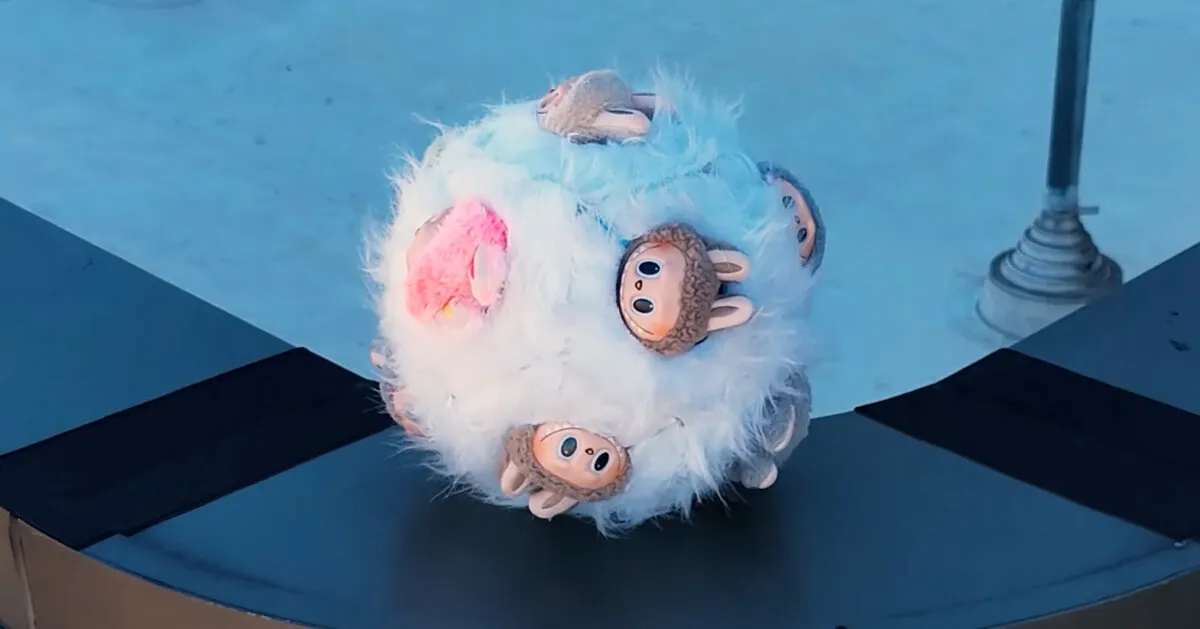

MIT has built a robot that looks less like the future of technology and more like something you would see in a cursed toy store at 2 AM.
It is called Labububot, and yes, it is exactly what it sounds like: a social robot assembled from twelve Labubu toy heads mounted around a rolling spherical body, each one able to shift and move in coordinated waves as the machine follows people through hallways.
And the weirdest part is that the unsettling vibe is not an accident. It is the whole point.
Meet the Monster
The project comes out of MIT Media Lab, where researchers Miranda Li, Jake Read, Dimitar Dimitrov, and Cynthia Breazeal decided to ask a question that most robotics teams usually avoid: what if a social robot did not try to be cute, comforting, or human-friendly?
For years, social robotics has mostly gone in one direction. Round eyes. Soft edges. Friendly voices. Little gestures designed to make people feel safe. The assumption has been that if you want humans to interact naturally with robots, the robot should feel approachable.
Labububot does not care about that assumption.
It leans the other way. Hard.
Imagine a rolling machine covered in identical mischievous toy faces, all subtly shifting at once, following you down a hallway like a tiny parade float possessed by a design thesis. That is the energy here.
Why Build Something So Unnerving?
The answer is something the researchers frame through monster theory, which is a very MIT way of saying: maybe discomfort is not a bug in human-machine interaction. Maybe it is a useful design space.
Instead of treating the uncanny valley as something to avoid at all costs, Labububot treats weirdness as a tool. If a robot makes you laugh, hesitate, stare, or feel slightly threatened in a controlled way, that emotional reaction might reveal more about how humans relate to machines than another smiling plastic assistant ever could.
That is what makes the project so much more interesting than a random toy hack.
This is not "look, we built a silly thing." This is "what if creepiness is an interface?"
How It Actually Works
Under the hood, Labububot is not magic. It is a carefully orchestrated robotic system. The machine uses a web-based control panel and a set of servo-driven Labubu heads that can move in coordinated patterns. As it rolls through a space, the heads can shift in waves, making the whole body feel strangely animated, as if the robot is thinking through facial repetition rather than through a single face.
That choice matters. A normal social robot usually tries to create a one-to-one relationship with a human. One body, one face, one personality. Labububot breaks that logic by giving you twelve versions of the same expression at once.
It is not one social cue. It is a chorus of them.
And that makes the machine feel less like a companion and more like an event.
Why Labubu?
Labubu, the designer-toy creature created by Kasing Lung, already occupies a strange cultural space. It is cute, but also slightly feral. Childlike, but a little chaotic. It is exactly the kind of object that feels harmless until someone multiplies it by twelve and mounts it onto a robot chassis.
Which is why it works so well here.
Labububot takes something that already lives on the border between adorable and unsettling, then pushes it a few steps deeper into the uncanny. It is familiar enough to be funny, but strange enough to make your brain keep checking whether it is actually okay with what it is seeing.
The Bigger Robotics Point
This is where the project gets genuinely smart.
Most conversations about robotics still assume the goal is smooth integration. Make robots more polite. More useful. More emotionally legible. Less weird. But what if weirdness itself teaches us something important?
A robot that unsettles people can expose hidden assumptions about trust, control, personality, and social behavior. It can show us how quickly we assign intention to movement. How sensitive we are to repetition. How thin the line is between cute and disturbing.
In that sense, Labububot is almost less like a product prototype and more like a psychological instrument. A haunted little probe sent into the human nervous system.
Coming Soon to a Hallway Near You
The robot is set to make its public debut this summer in London as a finalist in the International Conference on Social Robotics Grand Challenge. Which means a lot more people are about to experience the specific sensation of watching twelve Labubu heads glide toward them on a rolling machine built by some of the smartest people in one of the world’s most famous labs.
There are many ways MIT could have spent its time. Building an emotionally ambiguous toy-monster robot was apparently one of them.
Honestly, good.
Because for all the serious talk about AI and robotics, projects like this do something many polished product demos cannot. They make the future feel weird again.
And maybe that is healthy.
Not every robot should reassure you. Some should make you stop in the hallway, laugh nervously, and ask what kind of species builds a machine like this on purpose.
The answer, apparently, is ours.