
In 1946, a Hungarian mathematician named Paul Erdos published a paper that asked a seemingly simple question: if you scatter points across a flat surface, what is the maximum number of pairs that can sit exactly one unit apart?
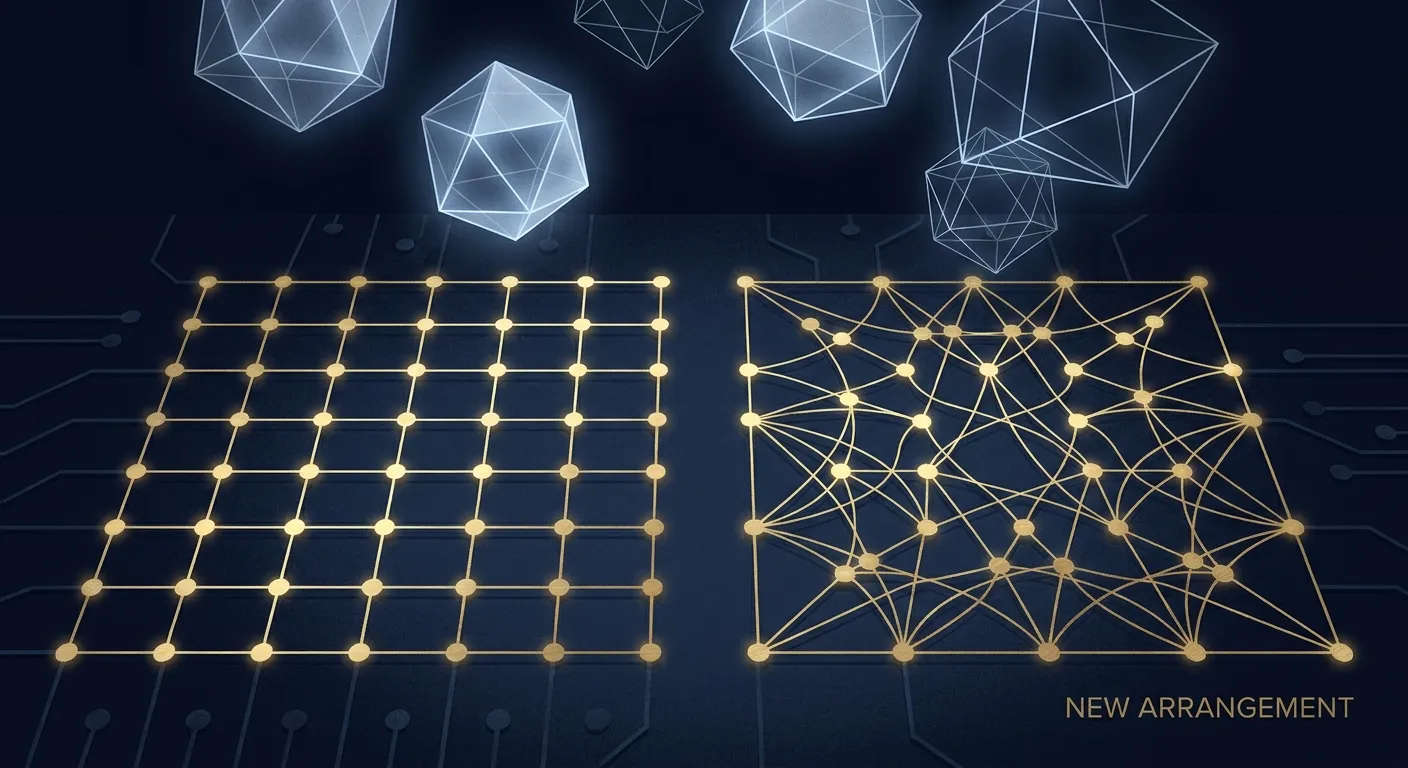
It sounds like a geometry class warmup. It was not. For eighty years, the best minds in mathematics chipped away at what became known as the unit distance problem, and for eighty years, nobody could beat the humble square grid. If you arranged your points in neat rows and columns like a checkerboard, that was it. That was the ceiling. Every mathematician who mattered assumed it was optimal.
They were wrong. And the thing that proved it was not a human.
OpenAI announced this week that one of its internal reasoning models has produced an original mathematical proof disproving Erdos’s conjecture. The model found new geometric constructions that outperform the square grid in ways nobody had imagined. Fields Medalist Timothy Gowers, one of the most respected mathematicians alive, reviewed the work and said it deserves publication.
Erdos himself was famous for offering cash bounties for solutions to his favorite problems. He once put five hundred dollars on this one. Adjusted for inflation, that is about seven thousand dollars today. It is not the money that matters, though. It is the fact that an AI just did something that generations of brilliant humans could not.
The proof itself is not some hand-wavy guess. The model produced explicit constructions — actual point arrangements — that beat the long-assumed square grid. Mathematician Will Sawin has since formalized the result on arXiv, confirming the lower bound of more than n to the power of 1.014 unit-distance pairs. The square grid gave you n to the power of roughly 1. The new construction squeezes out more.
Here is why this matters beyond a dusty math journal. For years, the debate about AI has been whether it can create or only regurgitate. Can it truly reason, or does it just pattern-match at scale? Disproving a conjecture that stood for eight decades is not pattern matching. It is not summarizing a Wikipedia article. It is noticing something that every expert in the field missed for a lifetime.
The method the model used is arguably the most interesting part. Instead of brute-forcing every possible arrangement, it seems to have discovered a structural insight — a way of packing points that exploits geometric relationships humans had not thought to explore. The exact construction is still being digested by the mathematical community, but the fact that a machine found it at all is the headline.
Of course, there are caveats. The model did not operate in a vacuum. Human mathematicians set up the problem, reviewed the output, and formalized the proof. Gowers himself noted that the AI’s reasoning chain is not fully transparent, which makes some purists uncomfortable. Mathematics has always been about understanding, not just answers. An oracle that whispers truth but cannot explain itself is useful, but it is not the same as insight.
Still. Eighty years. Thousands of papers. The greatest geometers of the twentieth century. And a machine running in a server room somewhere found the crack in the wall.
What is next? Erdos left behind hundreds of unsolved problems, many with bounties still outstanding. If one has fallen, the others might not be far behind. The mathematicians of the future may spend less time grinding at blackboards and more time learning to ask the right questions of systems that can explore spaces no human mind could ever traverse.
Or maybe the real story is simpler. Maybe we just built something that is really, really good at geometry, and it turns out geometry was waiting for a fresh set of eyes — even if those eyes are made of silicon.
Either way, Paul Erdos would have been thrilled. He loved impossible problems, and he loved when the universe surprised you. An AI proving him wrong eighty years later? That might be the most Erdos thing imaginable.