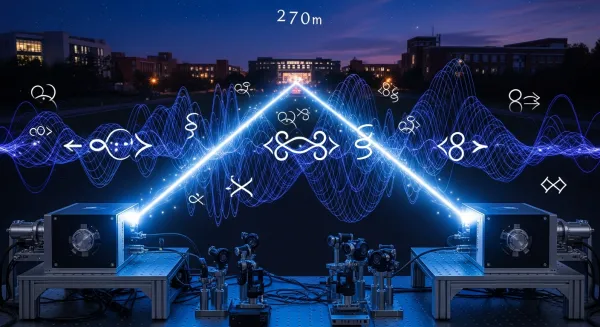

AI has a power problem. Every time we ask a model to generate an image, summarize a meeting, or pretend to understand our spreadsheet, somewhere a server is burning real energy and shedding real heat. That is why a new experiment from the University of Pennsylvania feels so intriguing. Instead of pushing electrons around like normal chips do, the researchers built a device that lets light do the switching.
Not just light moving information around, which photonic systems already do pretty well. Actual switching, the logic-like behavior that computing depends on. And they pulled it off using something with a name that sounds like it escaped from a sci-fi word generator: exciton-polaritons.
If you have never heard of an exciton-polariton, do not worry. The short version is that it is a hybrid creature made by strongly coupling light with matter inside an ultra-tiny structure. It keeps some of light's best traits, like speed and low loss, but also gains the ability to interact more strongly, which is the part ordinary photons are famously bad at.
That matters because modern AI hardware is running into a very annoying bottleneck. Light is great for moving data quickly, but when you want a chip to make decisions, apply nonlinear operations, or do the messy parts of computation, most experimental photonic systems still have to convert the signal back into electronics. That is like building a bullet train that keeps turning back into a bus at every major station.
Penn's team says their device can do all-light switching at around 4 quadrillionths of a joule. That is such a silly-small number it barely feels real. The researchers say it is far less energy than what you need to briefly power a tiny LED. In practical terms, that means a future chip might be able to handle some of AI's most energy-hungry steps without constantly bouncing between light and electricity.
And yes, this is still early. Nobody is claiming your laptop is about to become a beam-of-light wizard next year. This is lab research, not a product launch. But it points at a very real future direction: computing systems that waste less energy as heat because they are doing more of their work optically from the start.
The timing is what makes this especially fun. We are in a weird era where AI progress is no longer limited just by clever models. It is also limited by power bills, cooling systems, data center buildouts, and the basic physics of how much heat you can tolerate before everything starts feeling like a toaster oven with venture funding.
That is why this story belongs in the Future category. It is not just about a clever materials science trick. It is about a possible escape hatch from one of the biggest invisible problems in computing.
If this line of research scales, you can imagine cameras feeding optical information straight into photonic chips, AI accelerators doing more work without detouring through electronics, and maybe even some baby-step quantum applications riding along on similar architectures. It is the kind of breakthrough that sounds tiny now, but could end up mattering a lot if the rest of the stack catches up.
Also, let's be honest, there is something delightful about the symbolism here. For decades, computing has meant forcing electrons through ever-denser mazes and then desperately dealing with the heat. Meanwhile photons have been standing off to the side like, "I am literally light, maybe use me more."
The best takeaway is probably this: the future of computing may not just be faster chips. It may be chips that are built around entirely different physical habits. Less shove, less friction, more glide.
And if that future arrives, a lot of it may start with weird little quasiparticles in a nanoscale cavity, quietly proving that light can do more than just carry the message. It might help write the message too.
Sources: Penn Today (May 2026); EurekAlert!; Physical Review Letters; Phys.org