
Stop me if you have heard this one before. A team of physicists in Europe just teleported a photon across 270 meters of open air, and it is not science fiction. It is the real deal, published in Nature Communications, and it brings the long-promised "quantum internet" one giant leap closer to reality.
Here is the kicker: they did not teleport matter. They teleported information... the complete quantum state of a single photon, transferred instantly from one independent quantum dot to another, with nothing but Roman skyline in between. Think of it like faxing the soul of a particle. The original is destroyed in the process, so no, we are not beaming people to Mars anytime soon. But for secure communication, this is absolutely revolutionary.
What Actually Happened
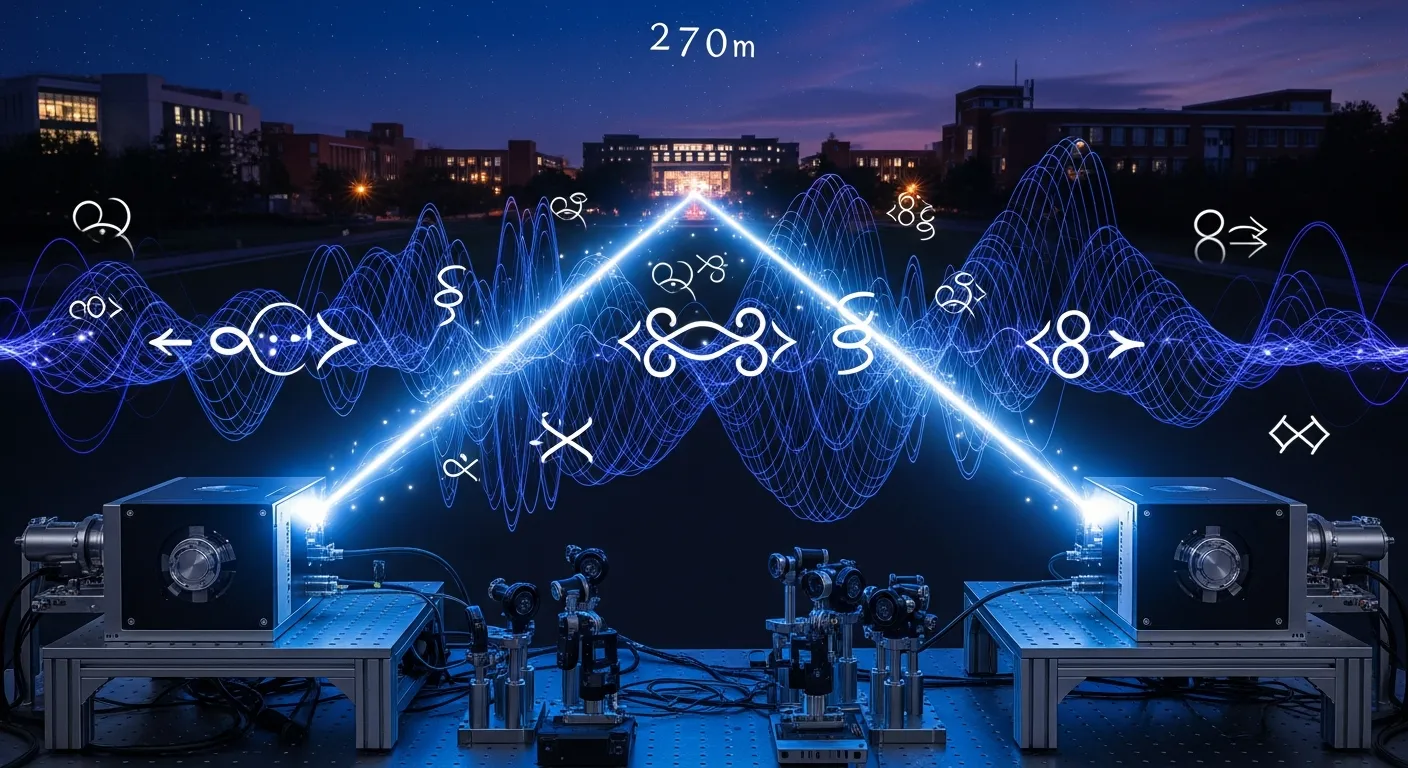
The experiment was a collaboration between Paderborn University in Germany and Sapienza University in Rome. Two teams set up separate quantum dots, tiny semiconductor crystals that spit out single photons on demand. One dot generated the photon whose quantum state would be teleported. The other produced entangled photon pairs to create the teleportation channel.
A 270-meter free-space optical link stretched across the Sapienza campus, exposed to real urban conditions: wind, temperature swings, and the ambient light of a working university. No fancy fiber-optic cable. No vacuum tube. Just open air, physics, and a whole lot of precision engineering.
The result? An 82 percent fidelity, well above the classical threshold of 67 percent. That means this was genuine quantum teleportation, not coincidence or clever copying. The polarisation state of the photon made the jump successfully, proving that two physically different, independently manufactured devices can talk to each other at the quantum level.
Why This Matters
Until now, most quantum teleportation experiments used identical or nearly identical photon sources. That makes the physics easier, but it dodges the real engineering problem. If the quantum internet only works when every node uses hardware from the same lab, it is not a network. It is a very expensive closed system.
This experiment smashed that barrier. The two quantum dots were grown independently, with distinct emission properties. Yet the team still managed to make their photons indistinguishable enough for the protocol to work. That is the hardware-agnostic breakthrough the field has been waiting for.
Even better, the photons were converted to telecom wavelengths, the same part of the spectrum your internet provider already uses. In principle, this technology could plug directly into existing fiber-optic infrastructure. The quantum internet would not replace the regular internet. It would sit alongside it, offering channels that detect any eavesdropping, secure links between quantum computers, and ultra-precise distributed sensing.
The Catch (There Is Always One)
270 meters is not exactly a global network. Scaling this to city-to-city distances means dealing with far greater atmospheric attenuation and timing uncertainty. The team used GPS-assisted synchronization to align photon arrivals without a shared clock, which is promising, but its performance over longer baselines remains untested.
Also, quantum teleportation cannot transmit information faster than light. A classical communication channel is still required to complete the protocol. So no, you cannot use this to send messages back in time. Sorry, sci-fi fans.
What Comes Next
The researchers are already looking ahead: longer distances over deployed fiber, higher fidelity, and integrating quantum memories so information can be stored as well as transferred. The ultimate goal is a network of quantum repeaters that could eventually span continents.
For now, the message is simple. The building blocks of a quantum internet are no longer just equations on whiteboards. They are sitting on optical tables in Europe, working, in real urban conditions, with imperfect hardware from different labs.
And that is exactly how you know the future just got a lot closer.