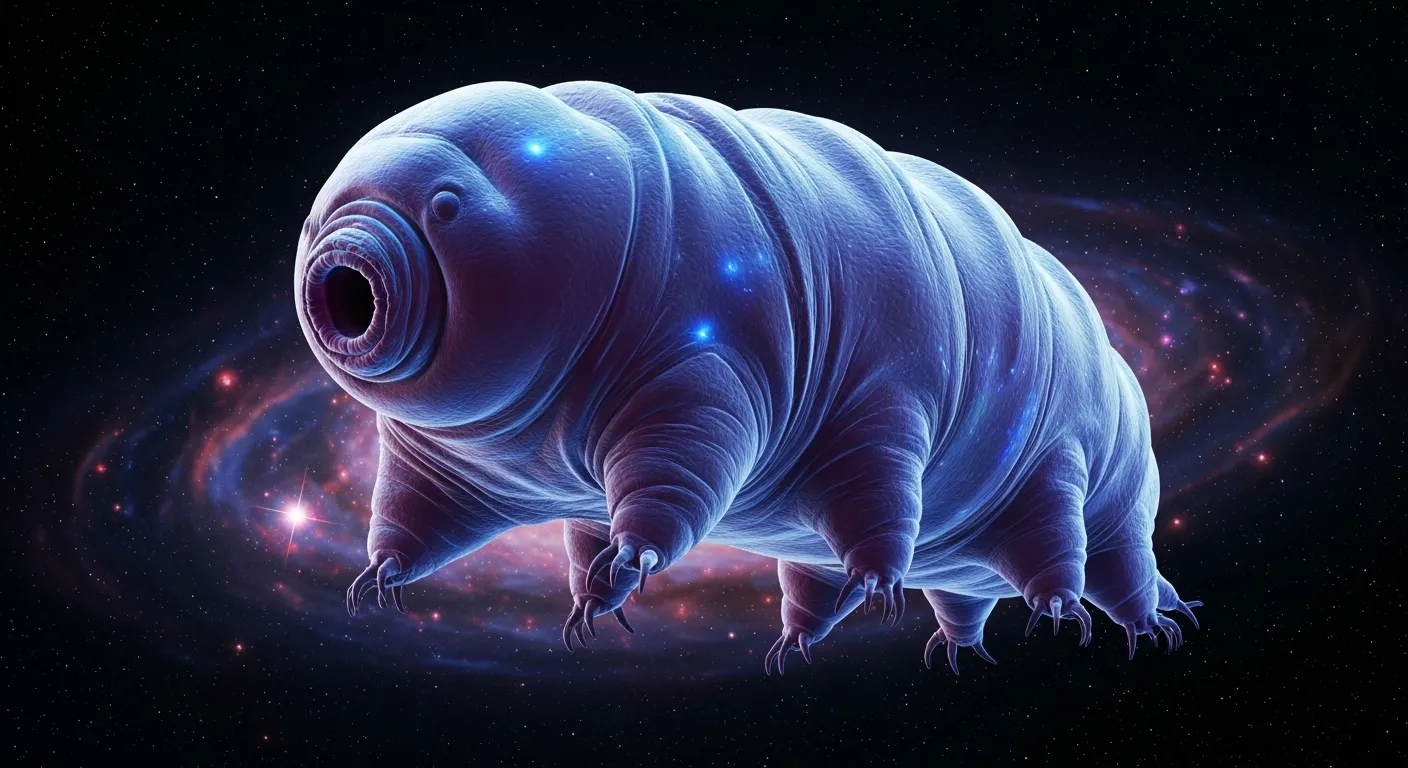

Meet the tardigrade. It looks like a microscopic bear had a baby with a vacuum cleaner bag, and it is officially the most indestructible thing on Earth.
These eight-legged weirdos, barely half a millimeter long, can survive being frozen to near absolute zero, boiled at 150°C, crushed under pressures six times what you'd find at the bottom of the ocean, and even the vacuum of space itself. They have been shot out of guns and survived. They can survive without water for decades by curling into a dried-out ball called a "tun."
But here's where it gets really wild. Scientists just discovered HOW tardigrades shrug off radiation that would turn most living things into soup.
The Nuclear Test
Researchers at the University of North Carolina decided to blast these little guys with gamma rays. We're talking 1,000 times the lethal dose for humans. Enough radiation to make Chernobyl look like a dental X-ray.
What happened? The tardigrades didn't die. They didn't even seem particularly bothered. They just... fixed it.
The Secret? DIY DNA Repair on Steroids
Here's the kicker. Scientists already knew about a protein called Dsup that protects tardigrade DNA like a microscopic bodyguard. But not all tardigrade species have this protein. So what was the backup plan?
It turns out these creatures have a completely different trick up their microscopic sleeves. When radiation hits, they don't just defend. They go into repair overdrive.
Within 24 hours of getting zapped, tardigrades crank up their DNA repair genes to maximum volume. The proteins produced by these genes become some of the most abundant molecules in their tiny bodies. They don't prevent damage. They just fix it faster than it happens.
It's like if your house got hit by a tornado, and instead of boarding up the windows beforehand, you just rebuilt the entire house in a day.
The Really Wild Part
The researchers took genes from these radiation-proof munchkins and popped them into E. coli bacteria. Those bacteria suddenly gained the same superpower. They could repair radiation damage just like the tardigrades.
This isn't just cool trivia about weird animals. This is potentially HUGE for medicine and space travel.
Radiation is one of the biggest problems for long-term space missions. Astronauts on Mars would face constant bombardment from cosmic rays that increase cancer risk and damage DNA. What if we could borrow tardigrade superpowers for human cells?
The researchers think this discovery could lead to new ways to protect animals, microorganisms, and maybe eventually humans from radiation damage. We're talking radiation-resistant crops, better cancer treatments, and astronauts who don't have to worry about their DNA unraveling on the way to Mars.
The Takeaway
Life finds a way, as the saying goes. But tardigrades don't just find a way. They bulldoze through every obstacle biology throws at them, rebuild whatever breaks, and keep on waddling on their stubby little legs.
Next time you think you're having a rough day, remember: somewhere out there, a creature the size of a speck of dust is shrugging off conditions that would vaporize almost everything else alive. And it's doing it with style.
The universe is weirder and more wonderful than we ever imagined. And sometimes, the weirdest wonders are smaller than a grain of sand.
Based on research published in Current Biology by Courtney Clark-Hachtel et al., 2024.