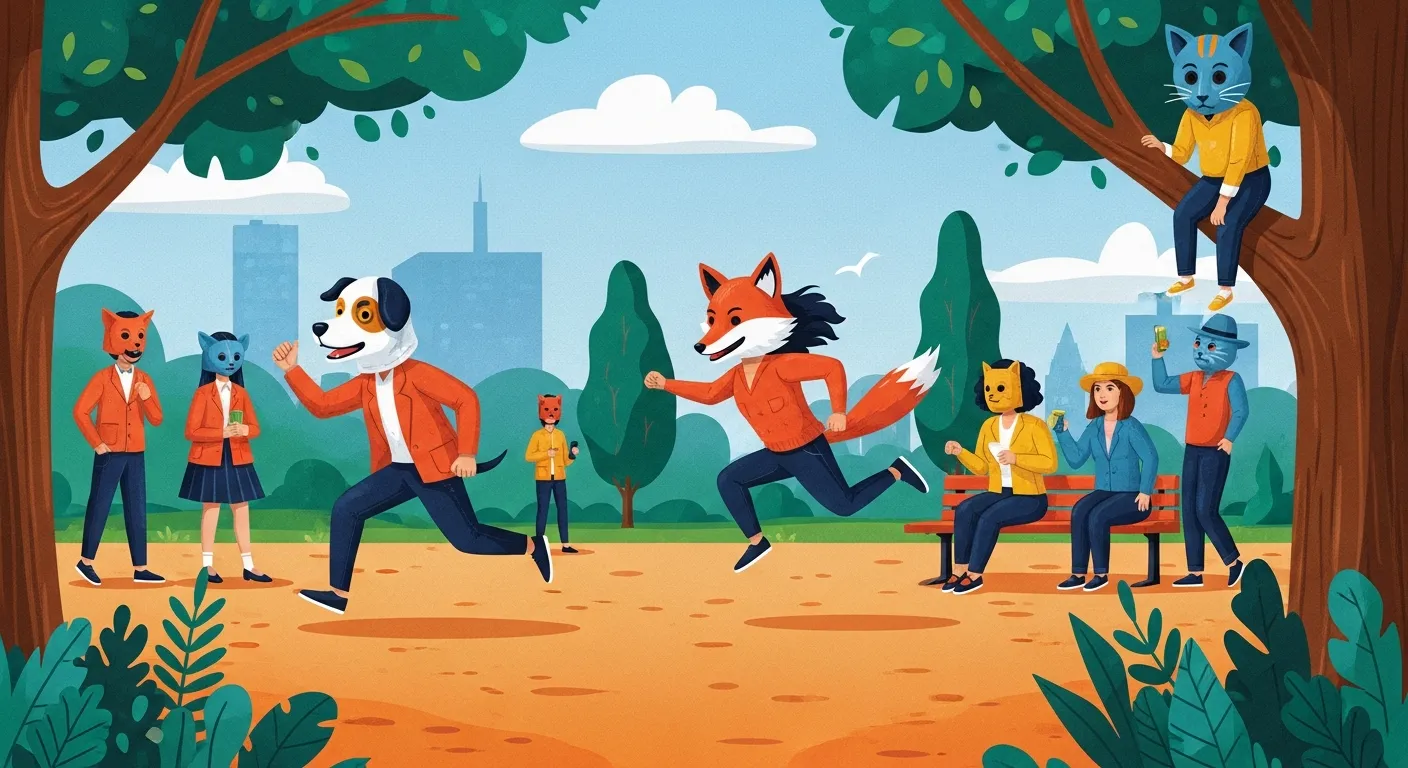

On Sundays in Buenos Aires, the park turns into a tiny alternate universe.
One teenager in a beagle mask sprints across the grass on all fours. Another, dressed like a fox, vaults over a little obstacle course with the seriousness of an Olympic trial. Someone else is up in a tree in full cat mode, refusing eye contact with the humans below. If you wandered into the scene with no context, you would assume a very specific portal had opened.
But this is not performance art and it is not a prank. It is part of the growing world of therians, people who say they identify mentally, spiritually, or psychologically with non-human animals. And in Argentina, the whole thing has exploded online.
According to the AP, the hashtag #therian has passed 2 million posts, with Argentina leading Latin America in engagement. That is a lot of dog masks, fox tails, and deeply confused adults.
Quick vibe check
If you had to pick a park persona for one day, what is your energy?
Golden retrieverTree catFoxSeal
Choose wisely.
The internet, naturally, has handled this with its usual emotional balance. Some people are fascinated. Some are annoyed. Some are acting like society ended because a 16-year-old in a seal mask went viral on TikTok. Which feels like a dramatic response to a teenager doing teenager things in a slightly more imaginative costume.
That is what makes this story interesting. On the surface, it looks absurd. Underneath, it looks familiar.
Every generation invents new ways to signal identity, belonging, and escape. Sometimes it is punk. Sometimes it is cosplay. Sometimes it is stan culture, sneaker culture, or cottagecore. The details change, but the engine is the same. Young people try on selves in public and see what fits.
For some therians, this goes beyond dress-up. They describe it as a real inner identification with an animal. For others, especially those in the "otherpaw" crowd, it is more like playful self-expression with masks, tails, and movement. That distinction matters, because the entire conversation gets dumber when adults flatten all of it into one big panic blob.
A Buenos Aires psychologist quoted by the AP made the point clearly. Symbolic identification is not automatically dangerous. It only becomes alarming if someone loses touch with reality in a way that causes harm. That feels like a useful reminder in a time when the internet treats every niche subculture as either a revolution or a catastrophe.
Honestly, the most revealing part of the trend is not the animal identity itself. It is the pack part.
These teens are not just posting selfies. They are organizing meetups, building communities, inventing shared language, and making public spaces feel charged with secret meaning. That has always been irresistible youth-culture fuel. If adulthood is a long conveyor belt toward emails and calendar invites, then of course a bunch of teenagers would rather spend Sunday pretending they are foxes in a park. I kind of respect it.
Also, human social behavior is already weird. We wait in line for sneakers. We scream lyrics in arenas with strangers. We buy digital skins so our game avatar can wear a cooler jacket. A teen in a dog mask is not the moment civilization got eccentric. Civilization has been eccentric the whole time.
What Argentina seems to have produced here is a perfect modern curiosity story. It is visual, a little baffling, a little sweet, and impossible to ignore once you have seen it. It is half internet trend, half identity experiment, half park hangout. Yes, that is three halves. This story earned it.
And maybe that is the real reason it spread. Not because everyone suddenly wants to be an animal, but because the whole thing pokes at a deeper question: how much of being a person is already performance? Put a mask on that question and send it to TikTok, and of course it goes viral.
Somewhere in Buenos Aires right now, a teenager is probably leaping over a bench in a canine mask while an adult nearby mutters, “What is happening to the world?”
The world, for the record, is doing what it always does. Getting weirder, louder, more creative, and harder to summarize.
Source: Associated Press reporting from Buenos Aires on Argentina's growing therian meetups and social media trend, February 2026.