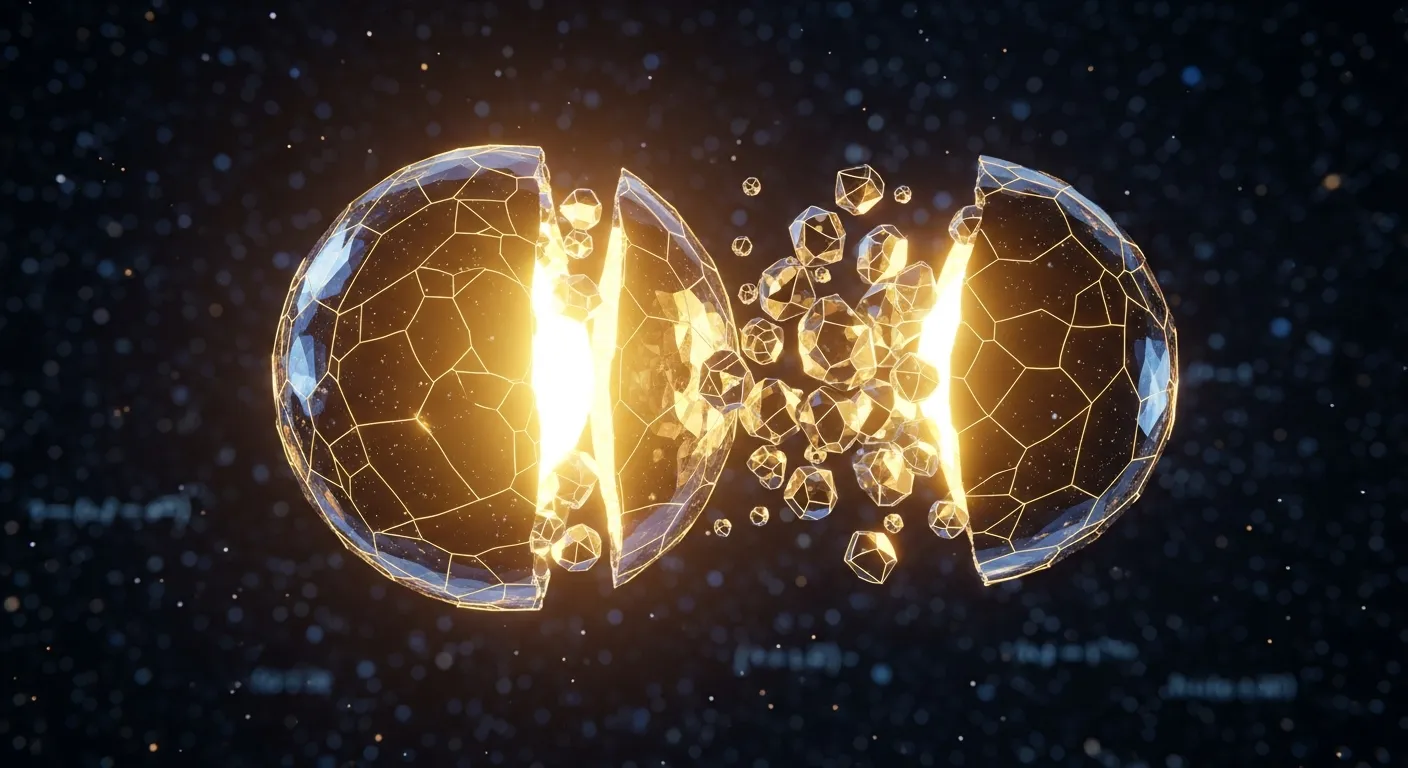

Here is a sentence that should not be true, but is: you can take a solid ball, cut it into a handful of weird pieces, rearrange those pieces without stretching or adding anything, and end up with two balls exactly the same size as the original.
Two. Full. Balls. Out of one. No magic, no 3D printer, no trick photography. Just a pair of Polish mathematicians in 1924 who proved it with formal logic.
Welcome to the Banach-Tarski paradox, the single most irritatingly true fact in all of mathematics.
The Setup That Broke Everyone's Brain
Stefan Banach and Alfred Tarski were not trying to break reality. They were just messing around with set theory, the branch of math that deals with collections of objects. Set theory is famously chill until it is not.
What they proved was this: given a solid ball in 3D space, there exists a way to decompose it into a finite number of pieces. Not infinitely many. A finite number. And those pieces can be moved around, rotated, and reassembled into two identical copies of the original ball.
It is called a paradox because it feels impossible. A ball has volume. Two balls have twice the volume. You did not add material. You did not inflate anything. Where did the extra volume come from?
The short answer: the pieces are not physically possible.
What These Pieces Actually Look Like
Here is the catch, and it is a big one. The pieces Banach and Tarski constructed are not nice. They are not chunks you could hold in your hand. They are not bounded by smooth surfaces. They are not even measurable in the normal sense.
Think of them as infinitely scattered dust. Each piece is so broken up, so riddled with holes at every scale, that it has no well-defined volume. The individual pieces are not solid objects in any physical sense. They are abstract sets of points, constructed using the Axiom of Choice, a controversial principle that says you can pick one element from each set in an infinite collection even if you have no rule for how to choose.
If you tried to build these pieces in the real world, you would need to cut atoms, then cut the subatomic bits, then keep cutting forever. The pieces are non-measurable, which is math-speak for "your kitchen knife is not up to the task."
Why Physicists Are Low-Key Panicking
Even though Banach-Tarski is purely mathematical, it touches something deep about how we define size, volume, and matter. In physics, conservation laws say you cannot create mass or volume from nothing. The paradox does not violate those laws because it operates outside the measurable, physical world. But it sits right at the edge, taunting us.
It is a reminder that our intuitive notion of volume, the thing that says "this ball is this big and that is the end of the story," is built on assumptions. If those assumptions relax even slightly, if we allow genuinely pathological objects into the mix, volume stops behaving the way we expect.
Some physicists have pointed out that quantum mechanics already deals with non-intuitive, non-local behavior at tiny scales. Could some quantum analogue of Banach-Tarski exist? Probably not in a literal way, but the thought is unsettling enough to keep a few grad students awake.
How to Explain This at a Party
If someone asks why Banach-Tarski matters, tell them this: it proves that the concept of "volume" is more fragile than it looks. We think of volume as a rock-solid property of objects, but it is actually a constructed idea that depends on which shapes we allow into the game. Allow the wrong shapes, and volume becomes meaningless.
It is also a masterclass in why mathematics and physics are different. In physics, if something is impossible in reality, it is impossible. In mathematics, if something is logically consistent, it exists, even if it would tear the universe apart if you tried it.
The video above is Michael from Vsauce walking through the paradox in his signature style. If you have twenty minutes and want your sense of reality gently dismantled, it is worth every second.
The Bottom Line
Banach-Tarski is not a recipe for cloning your coffee mug. It is a boundary marker. It shows us exactly where the math we use to describe the physical world starts to fray. On one side of the line, everything behaves. On the other side, one ball becomes two, and our brains refuse to cooperate.
The paradox is over a century old, but it still feels like a prank the universe is playing on us. And honestly? That is exactly why it is beautiful.